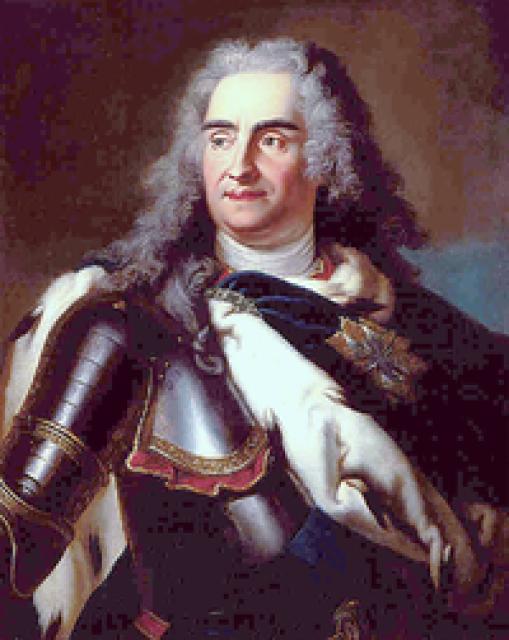
Avgust
 Poland
- Biography of August II the Strong
- The Northern War and Alliance with Russia
- European Wars and Struggles for Power
- Return to Power and Conflicts with Poland's Nobility
- Russian Mediation and Foreign Interventions
- Attempts to Maintain Polish Independence
- Legacy and Death
Biography of August II the Strong
Early Life and Rise to PowerAugust II the Strong (1670-1733), also known as Friedrich August I, was born on May 12, 1670 in Dresden. He was the second son of Johann Georg III, Elector of Saxony. In 1694, he succeeded his older brother Johann Georg IV as Elector of Saxony. In 1697, with the support of Russia and Austria, as well as bribery of Polish nobles and his conversion to Catholicism, August II was elected King of Poland, defeating the French contender, Prince Conti.

The Northern War and Alliance with Russia
During the Northern War (1700-1721), August II fought on the side of Russia against Sweden. He gained the nickname "the Strong" due to his legendary physical strength. However, his military campaigns were largely unsuccessful. In 1702, he suffered a defeat and was stripped of the Polish throne in 1704. He signed the Altranstädt Peace in 1706, relinquishing his claim to the throne. However, after the Battle of Poltava in 1709, he was restored as King of Poland.
European Wars and Struggles for Power
August II participated in various European wars, but with little success. Throughout his reign, he faced opposition from Polish nobles and the magnates who resented his attempts to centralize power and the presence of Saxon troops in Poland. In 1704, his opponents formed the Warsaw Confederation and elected Stanisław Leszczyński, a Swedish candidate, as king. August II sought the assistance of Russia and signed an alliance with Peter the Great in 1705.
Return to Power and Conflicts with Poland's Nobility
After the Russian victory at the Battle of Poltava and the flight of Charles XII of Sweden to Turkey, Russian and Polish forces expelled the Swedish occupiers from Poland. August II regained his position as King of Poland. In 1710, the Warsaw Confederation was dissolved, and the Polish Sejm (parliament) renounced its claims on territories in Ukraine and Kiev. However, conflicts between August II and the Polish nobility continued, leading to the formation of the Tarnogród Confederation in 1715.
Russian Mediation and Foreign Interventions
The disputes between August II and the opposition led to foreign interventions in Poland's internal affairs. Russia, with its decisive influence in Poland, supported the Sandormierz Confederation, while Austria and England supported August II. In 1717, a compromise was reached between August II and the opposition, which resulted in the removal of Saxon troops from Poland and the limitation of the size of the Polish army.
Attempts to Maintain Polish Independence
In an effort to counter the plans of Peter the Great, August II signed the Treaty of Vienna in 1719 with Austria and England, which aimed to protect the independence of Poland. In response, Russia and Prussia formed an alliance in 1720, guaranteeing the preservation of Poland's existing government. Russian diplomacy successfully prevented the ratification of the Vienna Treaty by the Polish Sejm. Prussia repeatedly attempted to exploit Poland's difficulties and proposed plans for territorial division.
Legacy and Death
August II the Strong died on February 1, 1733 in Warsaw. Despite his physical strength and grand ambitions, his reign was marked by conflicts with Polish nobles, foreign interventions, and limited military successes. He left a complex legacy, with mixed views on his efforts to centralize power and strengthen Poland's position in European politics.


