Avgust II Silnyi
 Poland
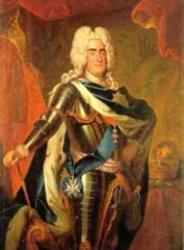
Augustus II the Strong ruled two very different political worlds: Saxony, where he was an elector and builder of a brilliant court, and the Polish-Lithuanian Commonwealth, where he was an elected monarch whose power was often contested. A striking, forceful figure, he pursued dynastic ambition and spectacle with equal energy. His military record was uneven, but his patronage transformed Dresden into one of Europe’s most celebrated centers of art and craftsmanship.
From Saxon prince to Polish king
Born Friedrich August in Dresden on May 12, 1670 (May 22 in the Julian calendar then used in Saxony), he was the second son of John George III, Elector of Saxony, and Anna Sophie of Denmark. He received a court education and traveled through western Europe as a young man, including a formative stay in Italy that deepened his interest in music and the arts. He later served in campaigns against France.
The unexpected death of his elder brother in 1694 made Friedrich August elector of Saxony. Seeking the Polish crown, he converted from Lutheranism to Catholicism in 1697, since a Catholic ruler was required for the position. The election was disputed, but he secured the crown and was crowned King of Poland as Augustus II in September 1697. He ruled Saxony as Frederick Augustus I and Poland as Augustus II, linking the two states through a personal union.
War and contested rule
Augustus allied with Russia and Denmark against Sweden in the Great Northern War, which began in 1700. The conflict soon brought Swedish forces into Polish territory. Augustus lost the Polish crown in 1706 to Stanisław Leszczyński, the candidate backed by Sweden, while he retained the Saxon electorate. After Sweden’s defeat at Poltava in 1709, Augustus regained the throne with Russian support and ruled in Poland until his death.
His return did not make the Commonwealth easy to govern. Its elected monarchy and powerful nobles limited the king’s ability to direct policy, while the wars and foreign alliances further strained his authority. His ambitions to strengthen his position repeatedly met resistance. In Saxony, by contrast, he had a firmer base of power and could pursue an extensive program of court building and artistic patronage.
Dresden, art, and porcelain
Augustus’s appetite for grandeur helped make Dresden a European cultural capital. He developed the city’s royal collections and supported elaborate court architecture, including the Zwinger complex, conceived as an orangery, pleasure garden, and space for collections and festivities. He also built up the Green Vault, a celebrated treasury of precious objects.
His passion for Asian ceramics was especially influential. Seeking to rival the imported porcelain he collected, Augustus supported the experiments of alchemist Johann Friedrich Böttger and scientist Ehrenfried Walther von Tschirnhaus. Their work led to successful European hard-paste porcelain production in Saxony in 1709 and to the establishment of the Meissen factory. Meissen pieces became prized diplomatic gifts as well as luxury objects, and the factory remains closely tied to the story of his reign.
Family and legacy
Augustus married Christiane Eberhardine of Brandenburg-Bayreuth in 1693. She remained Protestant after his conversion, while their only legitimate son, Friedrich August, was raised as a Protestant and later succeeded his father as Augustus III of Poland and Frederick Augustus II of Saxony. Augustus’s private life attracted many stories, some inflated by legend, but his reputation for extravagance and numerous romantic entanglements became part of his larger public image.
He died in Warsaw on February 1, 1733. His reign left a mixed political legacy: the Great Northern War weakened Poland’s standing and increased Russian influence, while his court’s collections, buildings, and support for Meissen porcelain gave Dresden a lasting cultural inheritance.