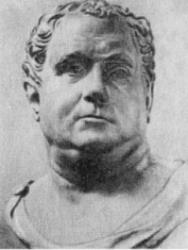
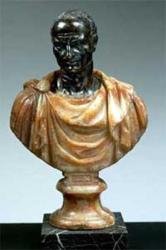
Avitus
 Italy
ItalyEmperor Avitus: A Unifying Force in the Declining Western Roman Empire
Early Life and Career
Avitus was born in Auvergne, Gaul into an affluent Gallo-Roman family around 390 CE. His father, Flavius Julius Agricola, served as consul in 421 CE. Avitus received a comprehensive education typical of his social status, including legal studies.
In his early career, Avitus served under the distinguished military leader Aetius in campaigns against the Visigoths, Burgundians, and Huns. His diplomatic skills were evident when he convinced Visigothic King Theodoric I to release his hostage relative, Theodosius. In 439 CE, Avitus became praetorian prefect of Gaul, enhancing his standing within the Western Roman Empire.
Rise to the Throne
After the death of Emperor Petronius Maximus in 455 CE, a delegation of seven Gallic provinces summoned Avitus to become emperor. This move was supported by the Visigoths, who proclaimed Avitus emperor in Toulouse. The Roman Senate ratified his appointment in 456 CE, and he arrived in Rome in September of that year.
Strengthening His Power
Avitus faced the challenge of consolidating support from various factions within the Western Roman Empire. He appointed several Gallo-Roman individuals to key positions in the imperial administration, aligning himself with the Gallic aristocracy. However, this move drew criticism from the Roman populace, who saw it as a diminution of their influence.
To maintain stability, Avitus relied heavily on military support from the Visigoths. He dispatched General Ricimer to Sicily to combat Vandal incursions, achieving some initial successes. However, the Vandal threat persisted, and the Roman treasury faced severe depletion.
Decline and Downfall
Avitus's attempts to unify the empire were ultimately unsuccessful. His policies alienated the Roman aristocracy and the people of Rome, who suffered from food shortages and the presence of foreign troops. In September 456 CE, Generals Ricimer and Majorian led a revolt against Avitus, who was forced to flee Rome.
The Roman Senate dethroned Avitus and appointed Majorian as emperor. Avitus fled to Gaul, but was pursued by Ricimer's forces. In October 456 CE, Avitus was defeated and captured near Piacenza. He was spared execution and became bishop of Piacenza, a role he held until his death in 457 CE.
Legacy
Emperor Avitus's reign was brief but significant. Despite the challenges he faced, he attempted to strengthen the Western Roman Empire by drawing support from various factions. His efforts laid the foundation for future emperors who would try to preserve the empire's unity in a time of decline and fragmentation.