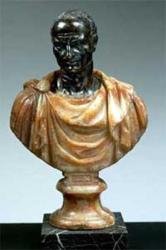
Diokletian
 Italy
Italy- Diocletian: The Architect of the Roman Dominate
- Reforms and Stabilization
- Tetrarchy and Abdication
- Later Life
Diocletian: The Architect of the Roman Dominate
Early Life and CareerBorn the son of a freedman, Diocletian's humble origins did not hinder his rise through the Roman army. He distinguished himself under Emperor Probus, becoming governor of Moesia. During the reign of Emperor Numerian, he commanded the imperial bodyguard and was proclaimed emperor after Numerian's untimely demise in 284.
Reforms and Stabilization
Faced with a severe crisis in the Roman Empire, Diocletian embarked on a series of sweeping reforms known as the Dominate, which sought to strengthen central authority and stabilize the state. In 286, he appointed Maximian as his co-emperor, or "second Augustus." In 293, he divided the empire into four regions within the framework of the Tetrarchy, assigning two junior co-emperors, or "Caesars," to assist the Augusti.
Diocletian reorganized the empire into 12 dioceses, each further divided into provinces. He maintained Rome as the nominal capital but established separate imperial residences in other major cities. By consolidating the vast Roman territories, Diocletian aimed to improve administration and strengthen imperial control.
Tetrarchy and Abdication
The Tetrarchy introduced a system of power-sharing and dynastic succession. Diocletian hoped to avert the internal struggles that had plagued previous emperors. However, the system proved unsustainable, and in 305, Diocletian and Maximian abdicated together. The empire was plunged into a period of civil war until the eventual emergence of Constantine the Great.
Later Life
Diocletian spent his remaining years in retirement at his luxurious estate in Salona (modern-day Split, Croatia). Despite his abdication, he maintained significant influence and played a pivotal role in the transition of power to Constantine.