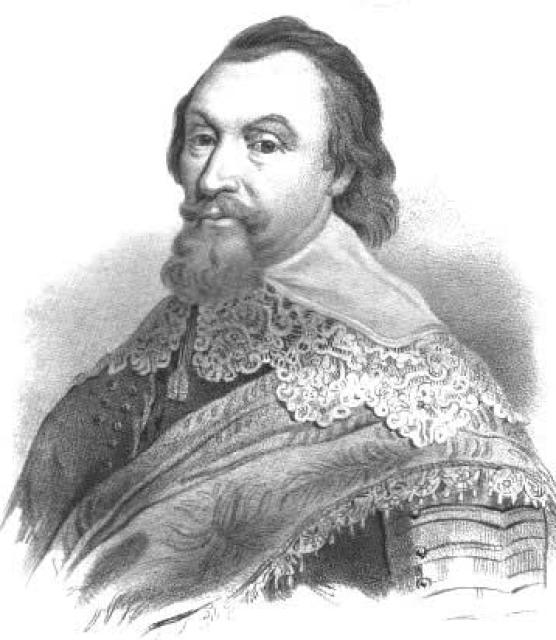
Axel Gustavsson Oxenstierna
 Sweden
- Axel Oxenstierna: Statesman and Architect of Swedish Power
- Early Life and Education
- Rise to Power
- Administrative Reforms and Foreign Diplomacy
- Leadership in the Thirty Years' War
- Formation of the Heilbronn League
- Final Years and Legacy
Axel Oxenstierna: Statesman and Architect of Swedish Power
Born in 1583, Axel Oxenstierna stands as one of the most influential figures in Swedish history. His remarkable career spanned decades of political, administrative, and military achievements.
Early Life and Education
Oxenstierna received his education at the University of Rostock and other renowned institutions in Germany. His exceptional intellect and ambitious nature paved the way for his early involvement in state affairs.
Rise to Power
In 1609, Oxenstierna ascended to the Swedish Privy Council, quickly gaining prominence due to his astute judgment and unwavering character. In 1612, King Gustav II Adolf appointed him as Chancellor, entrusting him with the formidable task of reforming the nation's administrative system.
Administrative Reforms and Foreign Diplomacy
Oxenstierna's reforms streamlined both central and local government structures, enhancing the efficiency of Swedish administration. He also played a pivotal role in shaping Sweden's foreign policy, brokering key agreements such as the Treaty of Knäred with Denmark (1613) and the Altmark Truce with Poland (1629).
Leadership in the Thirty Years' War
During the devastating Thirty Years' War, Oxenstierna served as Governor-General of occupied Prussia (1626-1631), securing vital funds for Sweden's military campaigns. In 1631, he joined the king in Germany, assuming command of Swedish forces with great success.
Formation of the Heilbronn League
In 1633, Oxenstierna realized King Gustav's vision by forming the Heilbronn League, a coalition of Protestant German states. He became its first and sole leader, but divisions within the League ultimately led to its dissolution.
Final Years and Legacy
Despite the League's demise, Oxenstierna remained an ardent advocate for Sweden's continued involvement in the war. His unwavering determination played a crucial role in securing favorable terms for Sweden in the Peace of Westphalia (1648).
As Chancellor and one of five regents during Queen Christina's minority, Oxenstierna wielded immense power. He is credited with drafting the "Instrument of Government" (1634), a constitutional document that shaped Sweden's governance.
Upon his return to Sweden in 1636, Oxenstierna ruled as the de facto leader for eight years. He orchestrated the attack on Denmark in 1643 and negotiated the advantageous Treaty of Brömsebro (1645), which further strengthened Sweden's position in Europe.
Axel Oxenstierna passed away in 1654, leaving behind an unforgettable legacy of leadership, diplomacy, and unwavering determination. His contributions to Sweden's崛起 as a major European power remain profound and enduring.