Ayanna Howard
 USA
USA- Ayanna Howard: A Genius in Robotics
- Education and Early Career
- Contributions at NASA and the Creation of 'HumAnS'
- Achievements and Recognition
- Media Appearances
Ayanna Howard: A Genius in Robotics
Ayanna McKall Howard was born on January 24, 1972, in Atlanta, Georgia. She is an American roboticist and a professor of electrical and computer engineering. Known as a true genius in robotics, Howard has made significant contributions to the field.

Education and Early Career
In 1993, Howard earned a Bachelor of Science degree in engineering from Brown University. She continued her studies at the University of Southern California, where she obtained a Master of Science degree and a Ph.D. in electrical engineering in 1994 and 1999, respectively. Her dissertation, titled "Recursive Learning for Deformable Object Manipulation," was supervised by George A. Bekey, a renowned American roboticist and honorary professor of computer science, electrical engineering, and biomedical engineering.

In 2005, Howard earned a Master of Business Administration degree with a specialization in strategy from Claremont Graduate University. Shortly after completing her studies at Brown University, she led a team in developing software for Axcelis, Inc. The team successfully created the first commercial software package for genetic algorithms, called "Evolver," which allowed personal computer users to solve a wide range of optimization problems.
Contributions at NASA and the Creation of 'HumAnS'
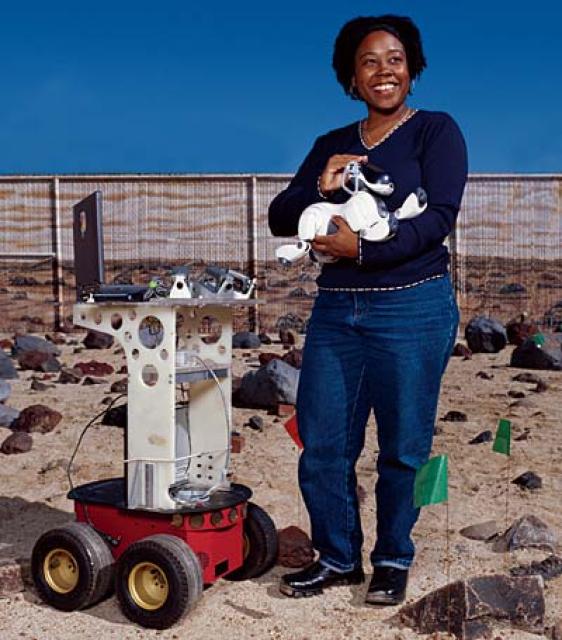
Howard later joined NASA's Jet Propulsion Laboratory, where she led several robot projects using soft computing techniques such as machine vision, fuzzy logic, and neural networks. Her most notable contribution was the development of the concept of a mobile system as the principal robotics investigator. In 2003, the magazine "Technology Review" recognized Howard as one of the world's top young innovators for her work in this field.
In 2005, Howard left the Jet Propulsion Laboratory and became an adjunct professor at the School of Electrical and Computer Engineering at the Georgia Institute of Technology. There, she founded the HumAnS (Human-Automation Systems) Laboratory. The laboratory primarily focuses on developing the concept of "humanized intelligence," which involves integrating human cognitive capabilities into the control of autonomous systems.
Achievements and Recognition
Howard's unique achievements have been reflected in more than a dozen scientific articles. In 2004, she was featured in the article "The Rise of the Machines" in TIME magazine. In 2008, she received international recognition for her robots called "SnoMote," which were designed to study Antarctic ice shelves and global warming. Equipped with cameras and sensors, the SnoMote robots do not require remote control and are capable of navigating the terrain effectively. Working in groups of 30 to 40, these robots will explore uncharted areas in the Arctic and Antarctica, analyzing micro-cracks in the icy landscape and changes in climate conditions.
Media Appearances
Howard has been a guest on various television programs, including CNN and PBS. Her expertise and groundbreaking work have made her a sought-after expert in the field of robotics.