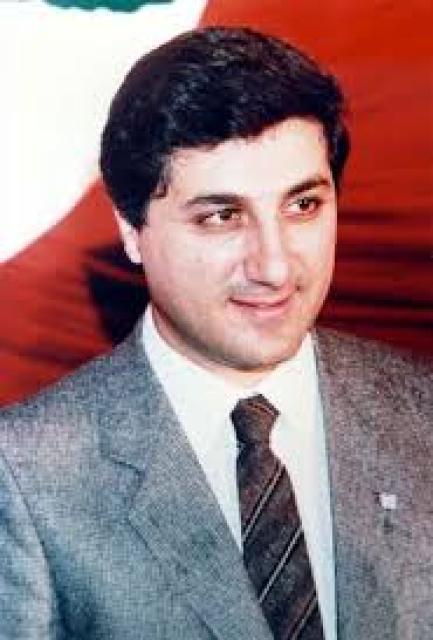
Bachir Gemayel
 Lebanon
- Early Life and Political Awakening
- Political Ascent and the Civil War
- Leadership of the Lebanese Forces
- Personal Life and Tragedy
- Conflict with Syria and Assassination
Bachir Gemayel: A Charismatic Leader and a Symbol of Lebanese Independence
Early Life and Political Awakening
Born on November 10, 1947, in Beirut, Bachir Gemayel was the son of Pierre Gemayel, the founder and longtime leader of the Kataeb Party. The Gemayel clan's ancestral home was in Bikfaya, a town in the Metn region northeast of Beirut.
In 1962, Gemayel joined the Kataeb Party, becoming active in its student organization. His involvement in politics intensified during the 1968 student colloquium organized by the newspaper "Orient." The event highlighted the growing divide between pro-Palestinian and pro-nationalist factions in the country's universities.
Political Ascent and the Civil War
Gemayel's kidnapping by Palestinian militants in 1970 had a profound impact on his views on the Palestinian issue. After completing his law and political science degrees from Saint Joseph University in Beirut, he was appointed as an inspector of the Kataeb Party's paramilitary wing in 1971.
In 1974, Gemayel established the "BG" unit, composed primarily of university students, to counter the threat posed by Palestinian terrorist organizations targeting Lebanese citizens. Following the outbreak of the Lebanese Civil War on April 13, 1975, Gemayel actively participated in combat operations with the pro-government Kataeb forces under the command of William Hawi.
Leadership of the Lebanese Forces
After Hawi's death in 1976, Gemayel became the head of the Kataeb's armed forces and later the overall leader of the Lebanese Front, an alliance of Christian militias. In 1976, he was appointed head of the unified command of the Lebanese Forces, a coalition of Christian pro-government militias.
In collaboration with the Syrian peacekeeping contingent, the Lebanese Forces defeated the National Patriotic Forces and Palestinian militants, who aimed to overthrow the Lebanese government and target the country's Christian community.
Personal Life and Tragedy
In 1977, Gemayel married Solange Tutundji. They had three children: daughters Maya and Youmna, and son Nadim. Maya was killed in 1980 in a car bomb blast intended for her father.
Conflict with Syria and Assassination
Relations between Lebanese Christians and the Syrian contingent deteriorated in 1978. Gemayel and his supporters demanded the withdrawal of Syrian troops, while others, led by former President Suleiman Frangieh, aligned with Syria. The conflict within the Lebanese Front intensified, leading to clashes between Kataeb and Frangieh's Marada party in northern Lebanon.
Following the assassination of Tony Frangieh, the commander of the Christian militia Army of Free Lebanon, in 1980, the Frangieh clan shifted allegiance to Syria. The Lebanese Forces clashed with the Army of Free Lebanon and Syrian troops, but Gemayel, to avoid civilian casualties, ordered his forces to retreat and evacuate the Zgharta and Koura regions.
Tragically, on September 14, 1982, just 21 days before his scheduled inauguration as President of Lebanon, Bachir Gemayel was assassinated by a bomb blast at the Kataeb Party headquarters. His death shocked the nation and plunged Lebanon into renewed conflict. Gemayel's legacy continues to be debated, but his charisma, political acumen, and unwavering belief in Lebanese independence left an indelible mark on the country's history.


