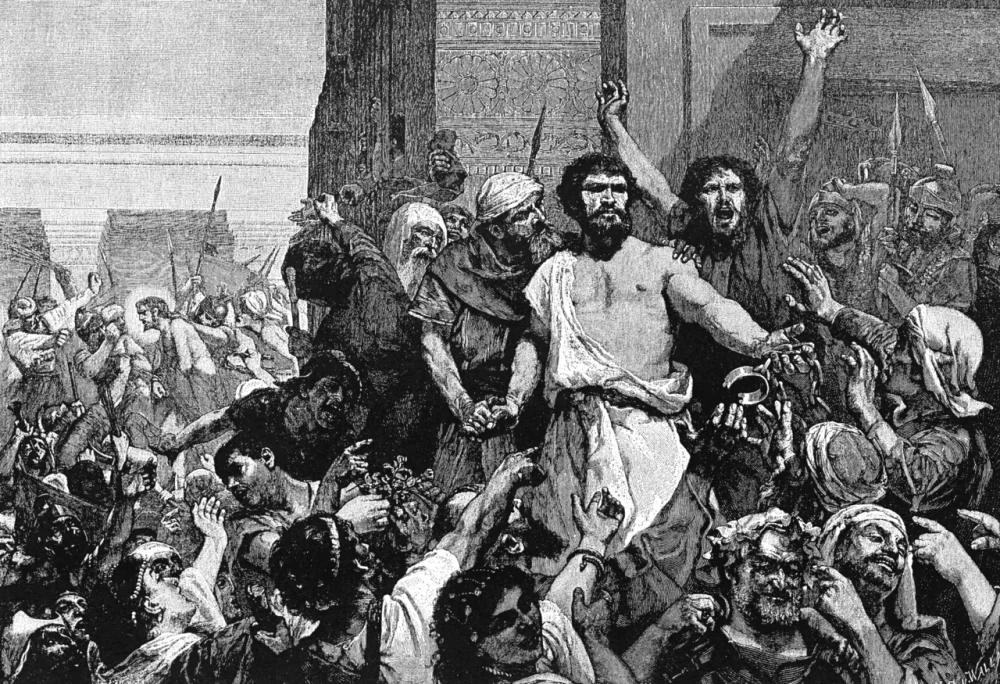
Barabbas
Barabbas appears briefly in the Gospel accounts of the trial of Jesus, yet his name carries a powerful contrast: one prisoner walks free while Jesus is sentenced to crucifixion. The biblical narratives offer no biography beyond this moment. Across the centuries, however, the episode has invited reflection on justice, political pressure, violence, and the meaning of substitution.
A prisoner before Pilate
The four canonical Gospels place Barabbas in Jerusalem during the events leading to Jesus’ execution. Pontius Pilate, the Roman prefect, is described as offering to release a prisoner at the time of the Passover festival. The crowd asks for Barabbas, and Pilate releases him while handing Jesus over to be crucified.
The accounts describe the prisoner in different ways. Mark and Luke associate him with an insurrection and murder; Matthew calls him a notorious prisoner; John refers to him as a bandit or rebel. These differences reflect the distinct emphases of the Gospel writers, who recount the same pivotal choice in their own narrative voices.
A brief story with wide meaning
The name Barabbas is commonly understood as an Aramaic form meaning “son of the father.” Some manuscript traditions of Matthew include the given name “Jesus” before Barabbas, though this reading is not present in all versions. The name has contributed to the story’s literary and theological force: the crowd is presented with two very different prisoners, and the choice becomes a dramatic hinge in the Passion narrative.
The Gospels say that Pilate’s offer was connected to a Passover prisoner-release practice, but historians have debated whether such a custom is independently documented and how the accounts should be understood. Barabbas is not mentioned in surviving sources outside the Gospel tradition, so little can be established about his life or the precise historical circumstances of the episode.
Interpretations through the centuries
Christian interpreters have often read Barabbas as a figure of release or substitution: the guilty prisoner is freed while Jesus takes the place of another. The episode has also been discussed in the context of Roman rule, popular pressure, and the politics of public justice. In sermons, art, drama, and literature, the name has become shorthand for the unsettling choice between mercy, power, and responsibility.
Because the biblical narrative gives Barabbas so little personal detail, he remains more a figure within a consequential scene than a fully drawn character. His brief release, however, has made him one of the most enduring presences in the story of the Passion.