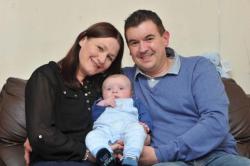
Becky Barletta
 Great Britain
- A Young British Woman's Battle with Frontotemporal Dementia
- Characteristics of Frontotemporal Dementia
- Family and Support
- Raising Awareness and Funding Research
- In 2015 alone, $818 billion was spent on dementia care worldwide.
A Young British Woman's Battle with Frontotemporal Dementia
Diagnosis and DeteriorationAt the tender age of 31, Rebecca "Becky" Barletta became one of the youngest victims of frontotemporal dementia (FTD), a debilitating condition that previously affected primarily the elderly. Becky's family first noticed uncharacteristic and inappropriate behavior in 2016. Initially suspected of depression, she was soon diagnosed with FTD.
Today, two years later, Becky's sister, Sophie Gilbert, shares her sister's story as one of "Britain's youngest dementia sufferers." Once a vibrant mother of two, Gilbert now resides next to her parents' home where Becky receives round-the-clock care from a live-in nurse. Becky's personality has transformed, and she rarely speaks, struggles to swallow, and has lost her ability to use the bathroom.
Once a ski instructor in Verbier, Switzerland, Becky enjoyed running, going to the gym twice daily, and was "a sociable extrovert." Now, she requires assistance for all daily activities, cannot drink by herself, and rarely interacts with others. Her health continues to decline rapidly, breaking the hearts of her loved ones.
"Becky has pretty much stopped talking," Gilbert said. "Beforehand, there was so much shouting, screaming, and repetitive stories, but now she just mumbles to herself."
"It was a bit annoying hearing the same stories again and again, but I knew I'd miss it when it went. And it has. That's gone."
Characteristics of Frontotemporal Dementia
FTD damages the frontal and temporal lobes of the brain, which control speech and behavior. Over time, FTD causes the brain to deteriorate, affecting a person's ability to speak, remember, and concentrate.
Becky is believed to have a genetic predisposition to dementia, as her maternal uncle and cousin both died from the disease.
Initially, doctors predicted that Becky could live for another 5-10 years after her diagnosis. However, her sister believes that "they were slightly optimistic" given the swift progression of her decline.
Gilbert fears for Becky's future, as there is no cure or plateau for her condition. While Becky's behavior has become easier to manage as her condition worsens, Gilbert notes that "she is quite unresponsive now. There's no reaction, and that's one of the hardest things to deal with. You never know if Becky's happy or sad."
Family and Support
Becky's husband, Luca, continues to work in the Alps but returns home every weekend to visit his wife and support her family.
The family regularly takes Becky to the doctor, but there is no way to slow the progression of her disease or even determine the exact cause.
"We want people to realize this could happen to anybody at any time," Gilbert said. "You could be in your 50s, in your 40s, and as our story shows, in your early 30s, too."
"Dementia at such a young age is something that almost nobody has heard of."
Gilbert admits that she panics every time she forgets something or bumps her car, fearing that she is the next victim of FTD.
Raising Awareness and Funding Research
Her family now supports the Alzheimer's Society and its annual Memory Walk fundraising event for dementia research. Last year, Memory Walk was held at Becky's parents' house, raising over £15,000 for the cause.
This year, there will be 41 Memory Walks across the UK, with a goal of raising £9 million. The number of people with dementia is on the rise as people live longer due to improved healthcare.
It is estimated that around 850,000 people in Britain, 5.7 million in the United States, and 425,000 in Australia have the brain-debilitating condition. Worldwide, there are around 50 million people living with dementia. Every three seconds, someone is diagnosed. By 2050, the number is expected to more than double to 131.5 million.
In 2015 alone, $818 billion was spent on dementia care worldwide.
Experts at the University of Exeter stated last year that there has been a "catastrophic shortage" of drug trials targeted at dementia, with researchers focusing more on cancer.
Currently, there are over 1,000 clinical trials worldwide looking for a cure for cancer, compared to just 142 for Alzheimer's disease. Of those 142 trials, only 29 have passed the first stage of testing, 40 times fewer than cancer drugs.
Scientists are urging for "urgent priority" to be given to dementia research, as there have been no new treatments developed since the 1990s.