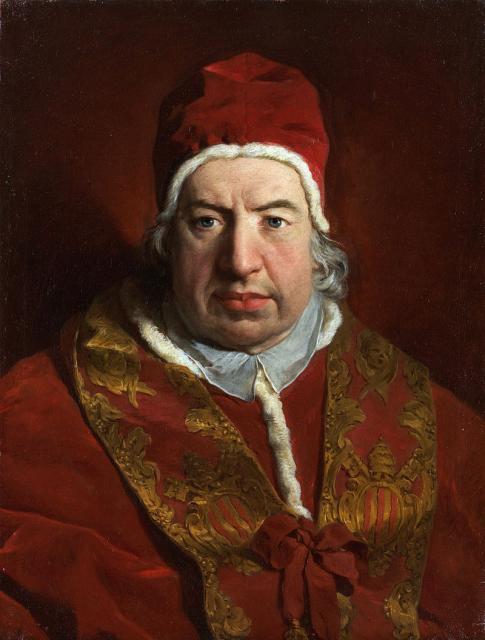
Benedictus XIV
 Italy
Italy- Early Life and Education
- Ecclesiastical Career
- Election to the Papacy
- Pontificate: Diplomacy and Reforms
- Death and Legacy
Early Life and Education
Prospero Lambertini was born on March 31, 1675, in Bologna, Italy. His father, Marcello Lambertini, was a senator, and his mother, Lucrezia Bulgarini, belonged to a wealthy bourgeoisie family. At the age of thirteen, Lambertini entered the Clementine College in Rome, where he excelled in rhetoric, Latin, philosophy, and theology. He later obtained doctorates in theology and law.
Ecclesiastical Career
After completing his studies, Lambertini joined the Roman Curia. His profound knowledge of canon law and人文主义earned him recognition. He was appointed bishop of Ancona by Benedict XIII and later became Archbishop of Bologna under Clement XII. Lambertini's amiable personality and lack of involvement in high-profile affairs made him an appealing candidate for the papacy.
Election to the Papacy
After the death of Clement XII, the conclave of cardinals struggled to reach a consensus. Lambertini's humility and reputation for integrity swayed the vote. On August 17, 1740, he was elected Pope and took the name Benedict XIV in honor of his predecessor.
Pontificate: Diplomacy and Reforms
Benedict XIV was a pragmatic and benevolent ruler. He aimed to strengthen the Catholic Church's position in Europe through diplomacy. He negotiated concordats with Savoy, Spain, Naples, and Portugal, granting concessions in exchange for securing ecclesiastical privileges.
Benedict XIV was also a patron of the arts and sciences. He founded the Roman Archaeological Academy, established scientific laboratories in the University of Rome, and created a special faculty for women in Bologna. He corresponded with leading Enlightenment thinkers, including Montesquieu and Voltaire.
In 1741, Benedict XIV issued the papal bull "Immensa Pastorum Principis," condemning the enslavement of indigenous peoples in the Americas and elsewhere. He declared a Jubilee in 1750 and commissioned a grand palace near St. Peter's Basilica, though the plans were not realized during his lifetime.
Death and Legacy
Benedict XIV's health declined in 1758, and he passed away on May 3, 1758, at the age of 83. His final words to his attendants were, "I leave you in the hands of God." He was buried in St. Peter's Basilica.
Benedict XIV is remembered as a tolerant and reform-minded Pope. He navigated the challenges of the Enlightenment era with moderation and diplomacy, earning respect and admiration from Catholics and Protestants alike.