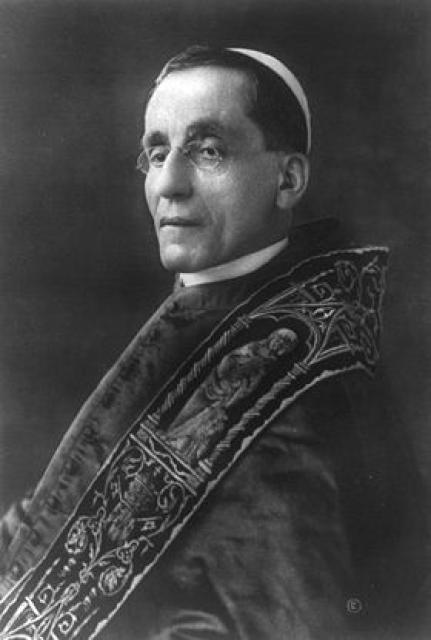
Benedikt
 Vatican
- Biography of Benedict XV
- Role during World War I
- Creation of the Congregation for the Eastern Churches
- Vatican's Role in Russia
- Policies and Legacy
- Death and Successor
Biography of Benedict XV
Benedict XV (Latin: Benedictus PP. XV, born Giacomo della Chiesa on November 21, 1854 – died January 22, 1922) was the Pope of the Roman Catholic Church from 1914 to 1922. He was born on November 21, 1854 in Pegli, near Genoa. Benedict XV studied law and theology, and was ordained as a priest in 1878. He then entered the papal diplomatic service. In 1907, Pope Pius X appointed him Archbishop of Bologna, and in 1914 he became a cardinal.
Role during World War I
Despite the outbreak of World War I, 60 out of 65 living cardinals gathered for the conclave after the death of Pope Pius X. After four days of deliberation, Cardinal della Chiesa was elected pope and took the name Benedict in honor of his great predecessor Benedict XIV. His Secretary of State was the distinguished jurist Cardinal Pietro Gasparri. Due to the raging war, papal diplomatic activity was limited. In 1918, Pope Benedict XV introduced the new Code of Canon Law. After Poland gained independence, the Holy See established diplomatic relations with the country.
Creation of the Congregation for the Eastern Churches
The events in Russia prompted Benedict XV to establish a special congregation for the affairs of the Eastern Churches on May 1, 1917. This congregation aimed to bring all Christian churches in the Middle East, the Balkans, Africa, and the Russian Orthodox Church under the authority of Catholicism. The Pope also established the Institute for Eastern Studies, which allowed Orthodox students to enroll. However, when the October Revolution emerged, Benedict XV believed that the Soviet government would be suppressed by a combined effort of internal counter-revolution and global imperialism.
Vatican's Role in Russia
The Vatican actively supported anti-Soviet elements in the Baltic countries of Lithuania, Latvia, and Estonia. They encouraged anti-Soviet activities and sought ways to penetrate Soviet Russia. In 1922, during a famine in Russia, the Vatican offered to send a mission to help the starving population. The Soviet government, wanting to avoid further tensions with the Catholic Church, accepted the mission. However, it was later discovered that the Vatican had used the members of the mission for interference in the internal affairs of the Soviet Union.
Policies and Legacy
Unlike his predecessor Pius X, Benedict XV pursued a more moderate course in church policy. He approved the Canon Law Code in 1917, which became the supreme law for the clergy and believers. Benedict XV also ended the persecution of modernists and allowed theological discussions within certain limits. He avoided excommunications and condemnations. Additionally, he dissolved the Congregation of the Index, transferring its functions to the Sacred Congregation of the Holy Office. Benedict XV was active in missionary work, expanding the activities of the Congregation for the Propagation of the Faith in Asia, the Middle East, and Africa. He urged missionaries to prioritize the interests of the Church over their own governments and to respect national cultures and customs. He aimed to strengthen the authority of Catholic missions among local populations, making their work more valuable for colonizers.
Death and Successor
Benedict XV passed away on January 22, 1922. On February 6, 1922, Cardinal Achille Ratti, the Archbishop of Milan, was elected as the new pope and took the name Pius XI.




