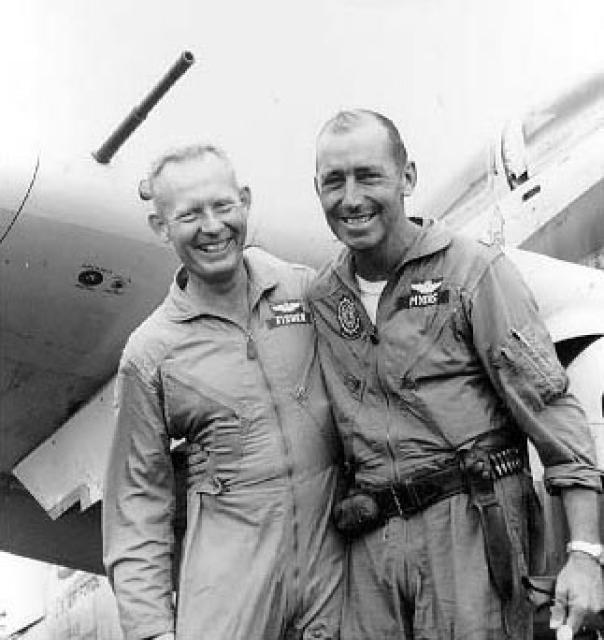
Bernard Francis Fisher
 USA
USABiography of Bernard Francis Fisher
Bernard Francis Fisher was a colonel in the U.S. Air Force and a participant in the Vietnam War. He was born in San Bernardino, California. Fisher briefly served in the U.S. Navy during the end of World War II and then in the Air Force National Guard from 1947 to 1950. He attended college and later the University of Utah, starting in 1949. In 1951, he joined the U.S. Air Force and served for a long time in the Air Defense Command, flying the F-104 interceptor.
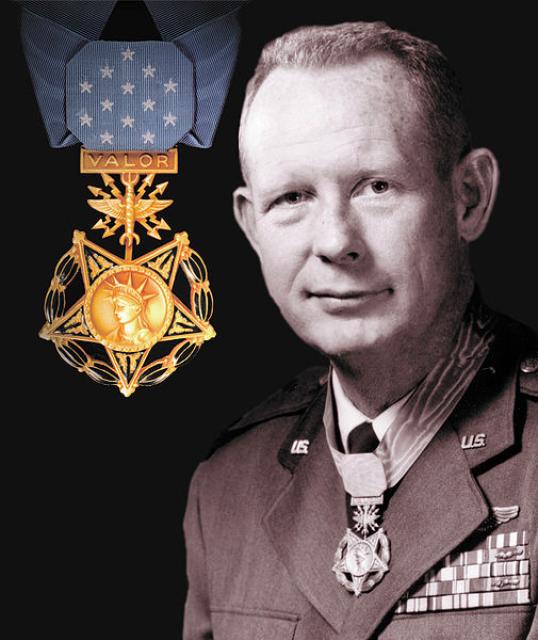
Service in Vietnam
In 1965, Fisher volunteered and was sent to Vietnam. He served in the 1st Air Commando Squadron, equipped with A-1 "Skyraider" attack aircraft. During his year of combat duty, Fisher completed 200 missions. On March 9, 1966, the American Special Forces camp in the A Shau Valley came under attack by a North Vietnamese army regiment. Major Fisher distinguished himself on the first day of the battle by acting as an aerial forward air controller, coordinating airstrikes and delivering supplies and medicine to the defenders of the camp. For his actions, he was later awarded the Silver Star.
The Rescue Mission
As the odds turned against the camp, it became evident on March 10 that it was doomed. In the afternoon, an evacuation of surviving Vietnamese militia and Green Berets was organized by Marine Corps helicopters. However, many helicopters were damaged by intense enemy anti-aircraft fire. Several hours before the evacuation, Fisher, flying as part of a Skyraider flight, participated in another bombing run against Vietnamese positions. One of the aircraft was shot down, caught fire, and made a forced landing on an abandoned airstrip near the camp. The downed pilot, Major Myers, was close to enemy positions, and the camp defenders couldn't assist him.
Believing that Myers was seriously wounded (he had escaped from the burning aircraft in a flaming flight suit) and seeing no other possibility for his rescue, Fisher landed his A-1 on the same airstrip to pick up Myers. The landing itself was difficult, as the strip was pockmarked with shell craters and littered with empty barrels, shell casings, and other debris. Under constant enemy fire, Fisher remained on the ground until Myers climbed into the cockpit of his aircraft (the A-1E was designed for two pilots, but in Vietnam, it was usually flown by one person) and then successfully took off. When they returned to base, Fisher's plane had 19 bullet holes.
Recognition and Later Life
In January 1967, Bernard Fisher received the Medal of Honor from President Lyndon B. Johnson. He remained in the Air Force until 1974. After retiring, he lived with his family in Kuna, Idaho. His wife Rialla passed away in 2008, and his son Steven serves in the U.S. Air Force. Several places and objects have been named in honor of Bernard Fisher, including a veterans memorial park in Kuna, a section of Highway 193 near Hill Air Force Base, a room at Kadena Air Base in Japan, and the container ship "Maj. Bernard F. Fisher" (T-AK-4396). His restored Skyraider is on display at the National Museum of the U.S. Air Force.



