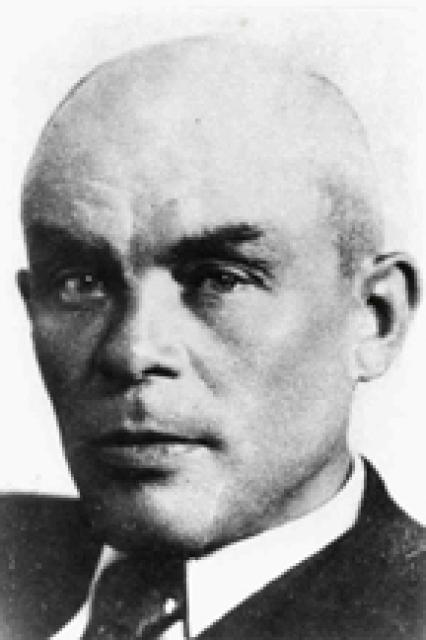
Stanislav Vaupshasov
- Early Life and Military Career
- Administrative and Security Roles
- Spanish Civil War
- World War II
- Post-War Activities
Early Life and Military Career
Stanislav Alekseevich Vovpsasov (also known as Vaipssas) was born in the Grozdziai village of the Siauliai district in the Kaunas province on July 27, 1899. The son of a laborer, he began his working life as a hired hand. In 1914, he moved to Moscow, where he worked as a ditch digger and rebar worker at the "Provodnik" plant.
In 1918, Vovpsasov joined the Red Guard, later transitioning to the Red Army. He saw action on the Southern Front, Eastern Front against General Dutov's forces and the White Czechs, and the Western Front. From 1920 to 1925, he engaged in covert operations as part of the reconnaissance intelligence unit of the Red Army in the Polish-occupied regions of Western Belarus. He became an organizer and commander of partisan detachments.
Administrative and Security Roles
From 1925 to 1927, Vovpsasov held administrative and economic roles in Moscow. In 1930, he began working for the GPU (State Political Administration) of the Byelorussian Soviet Socialist Republic (BSSR), eventually becoming the head of a section on the Moscow-Volga Canal construction project.
Spanish Civil War
In 1937-1939, Vovpsasov was deployed to Spain as a senior advisor at the headquarters of the Republican Army's 14th Partisan Corps, overseeing reconnaissance and sabotage operations. Using the pseudonyms "Sharov" and "Comrade Alfred," he risked his life to evacuate the republic's archives after the Republican forces were defeated.
World War II
Upon his return to Moscow in 1939, Vovpsasov joined the central apparatus of the NKVD (People's Commissariat of Internal Affairs). During the Soviet-Finnish War, he helped establish reconnaissance and sabotage teams. In 1940, he became a member of the Communist Party of the Soviet Union (CPSU).
From 1940 to 1941, Vovpsasov traveled abroad on intelligence missions to Finland and Sweden. Upon his return to the USSR, he was assigned to the Special Group of the 2nd Department of the NKVD.
During the Great Patriotic War, Vovpsasov served as a battalion commander in the NKVD's Special Purpose Motorized Rifle Brigade from October 1941, participating in the Battle of Moscow. From March 1942 to July 1944, under the alias "Gradov," he commanded the NKGB (People's Commissariat for State Security) partisan detachment "Mestnye" in the Minsk region of Belarus. Under his leadership, the detachment eliminated over 14,000 German soldiers and officers, conducted 57 major sabotage operations, including the bombing of the SS canteen that killed dozens of high-ranking German officers.
Post-War Activities
In 1945, Vovpsasov served in the central apparatus of the NKGB in Moscow. In August 1945, he participated in military operations against Japan and later led an NKGB task force to neutralize enemy agents in Manchuria.
From December 1946, Vovpsasov headed the intelligence department of the Ministry of State Security (MGB) of the Lithuanian SSR. He played a role in suppressing nationalist armed groups. In 1954, he retired from the military.
Vovpsasov authored the memoir "At Troubled Crossroads," which was published in Moscow in 1972. He was a recipient of the title Hero of the Soviet Union (1944), four Orders of Lenin, the Order of the Red Banner, the Order of the Patriotic War of the 1st and 2nd degrees, the Order of the Red Banner of Labor of the BSSR, and various medals. Stanislav Alekseevich Vovpsasov passed away in 1976.