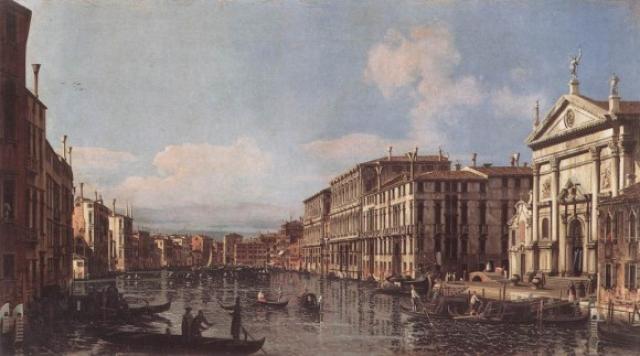
Bernardo Bellotto
 Italy
Italy- Bernardo Bellotto: A Master of the Venetian Landscape
- Artistic Career
- Artistic Style
- Notable Works
- Legacy
Bernardo Bellotto: A Master of the Venetian Landscape
Born in Venice on January 30, 1721, Bernardo Bellotto was the son of the painter Lorenzo Bellotto and F. A. Canal, the sister of the renowned artist Giovanni Antonio Canal, known as Canaletto. From 1735 onwards, Bellotto studied under his maternal uncle, inheriting the nickname "Canaletto." Often referred to as "Canaletto the Younger," their works were frequently confused in later traditions.
Artistic Career
Bellotto primarily worked outside Italy, spending significant time in Dresden (1747–1759), Vienna (1759–1760), Munich (1761), and Warsaw, where he settled after visiting Saint Petersburg in 1768. Like Canaletto, Bellotto combined Baroque and Classicist principles, employing the camera obscura to perfect the technique of the "veduta," a topographically precise depiction of a cityscape.
Artistic Style
Bellotto's artistic style differed markedly from his uncle's. While Canaletto's paintings exuded bright and festive colors, Bellotto's were characterized by a restrained, cool palette and a more rigorous approach. His large-scale compositions, often constituting extensive cycles, captured expansive cityscapes and natural environments. Despite their meticulous detail, Bellotto's works conveyed an additional layer of refinement.
Notable Works
Among his most renowned series are the Dresden and Pirna views, commissioned by Heinrich von Brühl, the minister of the Saxon Elector Augustus III (1747-1755). Many of these paintings are housed in the Gemäldegalerie Alte Meister in Dresden, with some others belonging to the Hermitage Museum in Saint Petersburg and the Pushkin Museum of Fine Arts in Moscow. Bellotto also created notable Polish views during his residency at the court of King Stanisław August Poniatowski.
Legacy
Bellotto's works made him an invaluable resource for the reconstruction of Warsaw's historical center after World War II, and later, Dresden's. His meticulous depiction of architectural details and city life proved essential for restoring these historic landmarks to their former glory. Bellotto died in Warsaw on October 17, 1780, leaving behind an enduring legacy as one of the most significant landscape painters of the 18th century.