Bessus
Bessus was a senior Persian noble who became one of the last challengers to Alexander the Great’s conquest of the Achaemenid Empire. As satrap of Bactria, he commanded troops at the Battle of Gaugamela and later seized the title of king after joining the conspiracy that ended Darius III’s life. His brief bid to rally the eastern provinces collapsed under Alexander’s relentless pursuit.
Satrap of Bactria
Bessus belonged to the Achaemenid ruling elite and governed Bactria, a large and strategically important province in the empire’s eastern reaches. The region, centered in what is now northern Afghanistan and adjoining Central Asia, was known for its cavalry and fortified settlements. Darius III appointed him satrap around 336 BCE, placing him in charge of troops and local administration.
When Alexander invaded Persia, Bessus led Bactrian forces at Gaugamela in 331 BCE. The battle ended in a decisive Macedonian victory, but Darius escaped eastward and attempted to regroup. Bessus accompanied the king during the retreat, as Alexander continued to advance through the empire’s interior.
The Fall of Darius III
In 330 BCE, as Alexander’s forces closed in, Bessus and other nobles arrested Darius. The king was wounded and left behind to die. Ancient accounts present Bessus as the principal conspirator, though they were written by Greek and Roman authors whose narratives often portrayed the Persians through the lens of Alexander’s victory.
After Darius’ death, Bessus assumed the royal title Artaxerxes V and tried to continue resistance in Bactria. His claim invoked his position within the Achaemenid family and the need to defend the empire’s eastern provinces. He was not simply fleeing: he sought to assemble a new military coalition and deny Alexander a quick conclusion to the conquest.
Pursued into Central Asia
Alexander followed Bessus across difficult terrain toward Bactria. Bessus withdrew eastward, destroyed river crossings, and attempted to gather support among local leaders. But his authority was weakened by the rapid collapse of the western empire and by disagreements among his own allies. Some leading commanders deserted him, while Spitamenes and other local powers pursued their own interests.
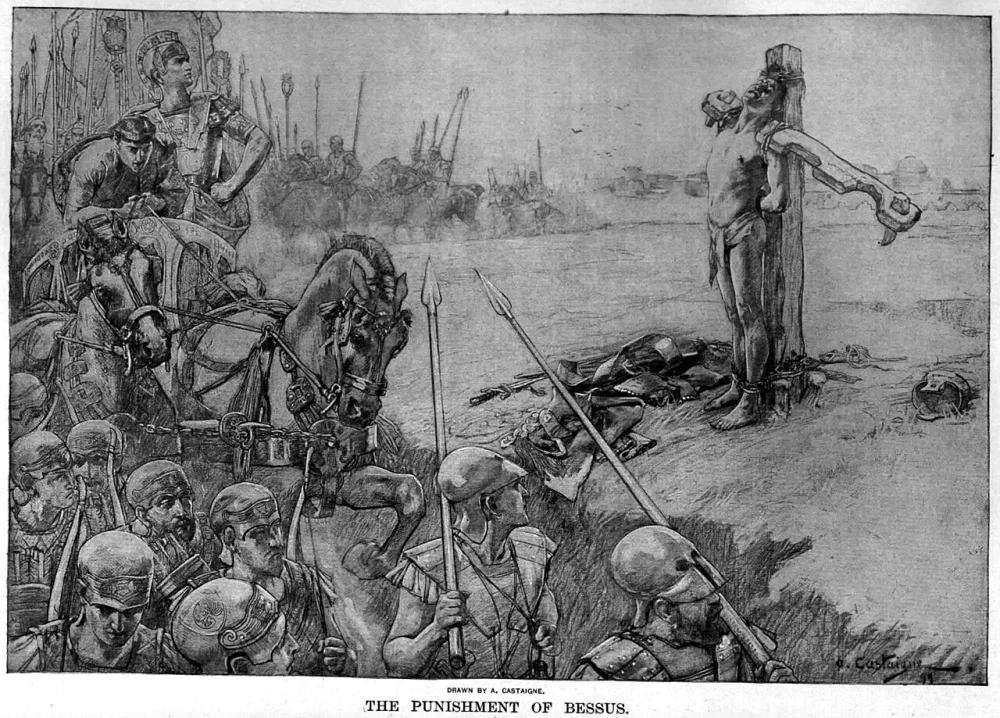
In 329 BCE, Bessus was captured after his companions turned him over to Alexander. The Macedonian king had him publicly punished for betraying Darius. Ancient sources describe his nose and ears being cut off before he was sent to Ecbatana for execution, although accounts vary over the precise sequence and location of his death. The punishment was meant to mark him as a regicide and usurper in the eyes of Persian nobles as well as Macedonian soldiers.
A Short-Lived Claim to the Throne
Bessus’ attempt to revive Achaemenid resistance failed, but Alexander’s conquest did not end with his capture. The eastern provinces remained difficult to control, and fighting continued for years in Bactria and Sogdiana. Bessus is remembered as the satrap whose seizure of power followed Darius III’s murder, a dramatic final episode in the fall of the Persian monarchy. His story also reflects the severe choices faced by provincial leaders as Alexander dismantled an empire and demanded their allegiance.