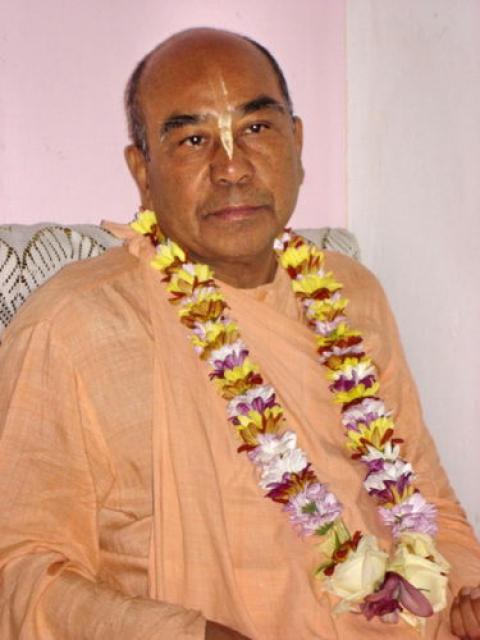
Bhaktisvarupa Damodara Svami
 India
IndiaBiography of Bhaktisvarupa Damodara Swami
Bhaktisvarupa Damodara Swami, an Indian Krishna-conscious guru, scholar-chemist, writer, and poet, was born on December 9, 1937, in the small village of Toubul in the kingdom of Manipur, then part of British India. Despite his Sikh surname, his parents were Vaishnava Hindus and raised him in the Vaishnava tradition. His father, Yogendra Singh, was a singer of Vaishnava bhajans in the Manipuri style of Nata Sankirtana. Bhaktisvarupa was the second of three children in the family.
Childhood
Bhaktisvarupa's childhood was difficult. In May 1942, when he was four years old, the Japanese began bombing Manipur. To escape the bombings, Yogendra and his family sought shelter in barracks on the banks of the Yangoy River. In 1944, Yogendra died of typhoid, and his brother, Toudam Ibomcha Singh, took care of the children. However, he was unable to support all three children, and two years later, Bhaktisvarupa ended up under the care of his older sister, Ahanbi. They lived in deep poverty and cultivated the land they inherited from their father to make a living. When Bhaktisvarupa was ten years old, he promised Ahanbi that when he grew up, he would earn a lot of money and buy her gold jewelry. Ahanbi replied that in the future, he would surely get married and decorate his wife with gold, not her. In response, Bhaktisvarupa promised never to get married. He kept his promise and remained celibate all his life. In 1949, Ahanbi got married, and Bhaktisvarupa was left alone. He attended a rural school and engaged in rice cultivation to support himself. He had very little time for studies and began considering leaving school. However, his school teacher came to his aid: with the help of the village elder, he convinced a local family to take Bhaktisvarupa under their care.
University Education and Spiritual Journey
At the age of 14, Bhaktisvarupa fell seriously ill with typhoid. Village doctors declared the case hopeless and that the child would die. The farmer who took Bhaktisvarupa under his care began praying to Krishna, reciting the "Dashavatar Stotra" (prayer to the ten incarnations of Krishna), and Bhaktisvarupa started fasting. After forty days of fasting and prayer, Bhaktisvarupa recovered. He regularly visited the village Vaishnava temple, worshiping the deities of Radha-Krishna, Gaura-Nitai, and Jagannatha, Baladeva, and Subhadra. As a child, he loved watching theatrical performances about Krishna's life. One night, Bhaktisvarupa watched a performance of the Rasa Lila (Krishna's playful dance with his beloved cowherd girls, the gopis) and the next day overslept his math exam. In 1961, Bhaktisvarupa graduated from Gauhati University with distinction and transferred to Calcutta University, where he earned a Master of Technology degree with distinction in 1964. The Ministry of Education of India awarded him a scholarship to study in the United States, which was an incredible achievement for an orphan from a poor Manipuri village. In 1969, Bhaktisvarupa obtained a Master of Science degree in chemistry from Canisius College (Buffalo) and began preparing his doctoral dissertation on organic chemistry at the University of California, Irvine.
During this time, one of Bhaktisvarupa's best friends joined ISKCON and became a disciple of Bhaktivedanta Swami Prabhupada, receiving the spiritual name Rai Ramananda Das. Rai Ramananda inspired Bhaktisvarupa to meet Prabhupada. Soon after meeting Prabhupada and the devotees, Bhaktisvarupa joined ISKCON and on June 30, 1971, he underwent the initiation ceremony, receiving the spiritual name "Svarupa Damodara Das" from Prabhupada. Over the next six years, he dedicated himself to the study of Gaudiya Vaishnavism philosophy and practice under the guidance of Prabhupada. Conversations between Svarupa Damodara and Prabhupada formed the basis for the popular book "Life Comes From Life," which discusses the contradictions between science and religion. In 1974, at the initiative of Bhaktivedanta Swami Prabhupada, the Bhaktivedanta Institute was founded. Prabhupada appointed Svarupa Damodara as the Institute's first director, as he was one of his few disciples with a doctoral degree. Prabhupada wanted the institute to propagate the "scientific nature of Krishna consciousness." According to the institute's charter, its main objective was to study the connection between Vedic knowledge and all aspects of human culture and present the results of this research in seminars, lectures, monographs, and scientific articles. The institute became Svarupa Damodara's tool for preaching Krishna consciousness to scientists. With his appointment as the director of the institute, Svarupa Damodara became an "intellectual and scientific leader of ISKCON." Prabhupada provided him with all the necessary means to carry out his preaching activities. In the following years, under Svarupa Damodara's guidance, the institute transformed into an intellectual center for the study of science and religion within ISKCON.


