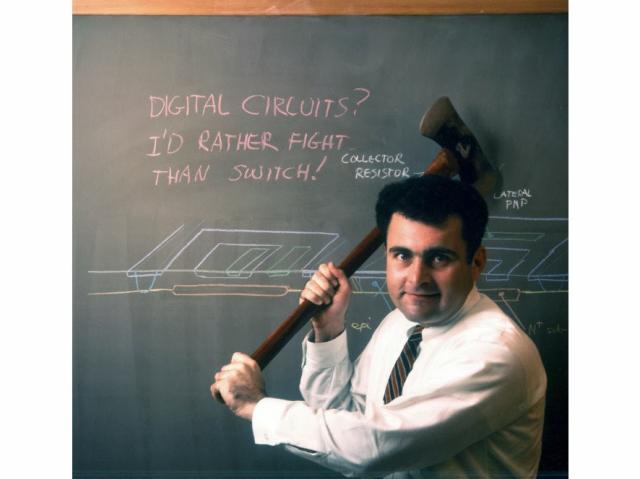
Bob Widlar
 USA
USA- Biography of Bob Widlar
- Early Life and Education
- Professional Career
- Contributions and Achievements
- Eccentricities
Biography of Bob Widlar
Bob (Robert) J. Widlar was an American electrical engineer, circuit designer, and developer of analog integrated circuits. He was born in 1937 in Cleveland, Ohio, and passed away on February 27, 1991, in Puerto Vallarta, Mexico.

Early Life and Education
Widlar grew up in Cleveland and joined the United States Air Force in 1958. In 1959, he became a student at the University of Colorado while also working at Ball Aerospace & Technologies Corp. He graduated from the university in 1962 and began his engineering career at Fairchild Semiconductor in 1963.

Professional Career
During his seven-year tenure at Fairchild Semiconductor from 1963 to 1970, Widlar played a significant role in the development of analog microelectronics. In 1966, Widlar demanded a salary increase from Fairchild, and when they refused, he joined National Semiconductor with exceptional contract terms for that time. Four years later, thanks to stock options and the increase in National's stock price, he retired as a multimillionaire and settled in Mexico while continuing to consult for National. In 1981, he became one of the co-founders of Linear Technology.

Contributions and Achievements
Widlar's professional achievements primarily occurred between 1963 and 1970, during which he obtained the majority of his numerous patents. In 1971, he received four U.S. patents, and during the rest of his life (1972-1989), he obtained eight more. Among his notable contributions to the field of electronics are the Widlar current source, the bandgap voltage reference, and the development of the first integrated operational amplifiers.

Widlar's designs, such as the μA702 (1963), μA709 (1965), LM101 (1967), and μA741 (1968), revolutionized the operational amplifier industry. The μA741, in particular, was the first operational amplifier with built-in frequency compensation and became one of the most widely used operational amplifiers in history.

Eccentricities
Apart from his technical contributions, Widlar was known for his eccentric behavior. He brought a sheep (or according to some sources, a goat) to the National Semiconductor office when the management stopped maintaining the lawns. He insisted on maintaining silence in the laboratories, allowing noise only during lunchtime. If someone made noise before lunch, Widlar would stand up and leave to have his lunch. He also installed an electronic circuit in the lab that emitted a sharp high-frequency tone whenever the noise level exceeded a certain threshold, ensuring that no one would ever shout at him.
Widlar also had specific preferences for the placement of equipment buttons, always insisting that the power button be located on the right side. When one of the test benches was built with the power button on the left, National technicians had to install a touch-sensitive switch at the right edge of the device to turn it on with a simple touch.
Additionally, Widlar occasionally visited the airport and purchased a round-trip ticket on the next available flight, demonstrating his spontaneous and unpredictable nature.
Despite his untimely death from a heart attack during a training run at the age of 53, Bob Widlar left a lasting legacy in the field of analog microelectronics, and his innovative designs continue to influence circuit designers to this day.


