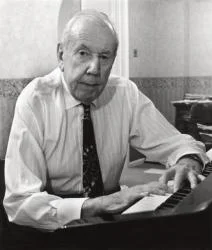
Bohuslav Martinů
- A Musical Childhood in Polička
- Paris and a Distinctive Style
- Exile and American Success
- Final Years and Legacy
Bohuslav Martinů was one of the most prolific Czech composers of the twentieth century, creating music that blended his homeland’s folk traditions with French modernism, jazz, and neoclassical forms. Forced into exile by the Second World War, he rebuilt his career in the United States and became an important voice in international concert life. His six symphonies, operas, ballets, and chamber works reflect a restless imagination shaped by migration.
A Musical Childhood in Polička
Martinů was born on December 8, 1890, in Polička, a small town in what was then Austria-Hungary and is now the Czech Republic. His father worked as the town watchman and lived with his family in a room high in the church tower. The unusual setting gave the boy a sweeping view of the surrounding landscape, while the close-knit town kept him connected to Czech folk music and local traditions.
He began studying the violin at age seven and made his public debut as a teenager. In 1906, the community raised money to send him to the Prague Conservatory. He was later dismissed for poor discipline, but he continued developing as a musician. In 1913, he joined the Czech Philharmonic as a violinist, an experience that introduced him to a wide range of orchestral repertoire.
Paris and a Distinctive Style
In 1923, Martinů moved to Paris, where he studied with composer Albert Roussel and absorbed the city’s lively musical scene. He encountered the modernist work of Igor Stravinsky, the music of Claude Debussy, jazz, and the experimental spirit of the French group known as Les Six. Rather than simply imitate these influences, he folded them into a voice marked by crisp rhythms, bright textures, and a strong sense of motion.
Martinů became increasingly drawn to neoclassical forms and Baroque concerto grosso traditions. Among his notable works from the interwar years were the opera “Julietta” and the “Double Concerto,” which was composed shortly before the 1938 Munich Agreement isolated Czechoslovakia from its allies. He married Charlotte Quennehen in 1931, and she remained his companion through years of travel and exile.
Exile and American Success
When Germany occupied France, Martinů and Charlotte fled south and eventually escaped to the United States in 1941. The Nazis had blacklisted him for his support of the Czechoslovak cause, making return to his adopted home in Paris impossible. In America, conductor Serge Koussevitzky championed his work, and Martinů received commissions from major orchestras.
His first symphony premiered in 1942, beginning a sequence of six. In 1943, he composed “Memorial to Lidice,” a powerful response to the Nazi destruction of the Czech village and the murder of its inhabitants. The piece combines a Czech chorale with a quotation from Beethoven’s Fifth Symphony, connecting national memory with a widely recognized musical symbol of resistance.
Martinů also taught and composed at a rapid pace, producing concertos, chamber music, and vocal works. A fall from a balcony in 1946 left him partially deaf in one ear, but his creative output continued. Although he hoped to return to Czechoslovakia after the war, the communist takeover in 1948 made that increasingly difficult.
Final Years and Legacy
After several years in the United States, Martinů returned to Europe in 1953. He taught at the American Academy in Rome and later lived on the Swiss estate of conductor and patron Paul Sacher. He continued composing until his final years, drawing increasingly on Czech and Moravian musical traditions.
Martinů died in Liestal, Switzerland, on August 28, 1959. His music remains central to the Czech repertoire while reaching far beyond it. Combining the rhythms of home with the musical languages he encountered in Paris and America, he created a body of work that speaks powerfully of both rootedness and exile.