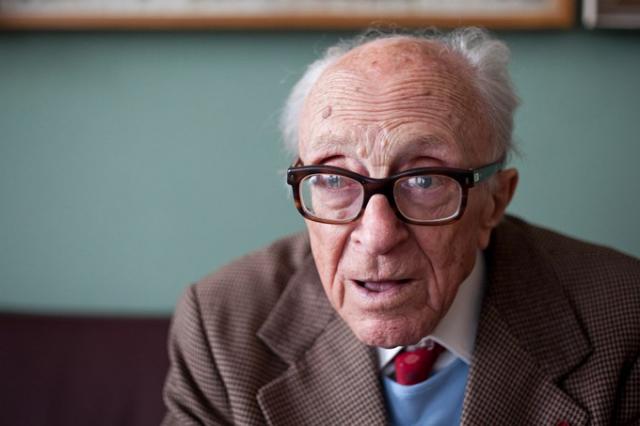
Boris Pahor
 Italy
Italy- Biography of Boris Pahor
- Early Life and Education
- World War II and Resistance
- Imprisonment and Liberation
- Later Life and Recognition
Biography of Boris Pahor
Boris Pahor is a Slovenian writer, considered one of the most prominent figures in Slovenian literature. He was nominated for the Nobel Prize in Literature by the Slovenian Academy of Sciences and Arts. Pahor gained recognition for his descriptions of his experiences in Nazi concentration camps.

Early Life and Education
Pahor was born in Trieste, which was then the main port of the Austro-Hungarian Empire. He witnessed the rapid rise of fascist ideology in what was once a relatively peaceful society. This experience influenced his decision to become a fighter against totalitarianism in all its forms. In 1920, Pahor witnessed the burning of the Slovene Community Hall in Trieste by fascists, an event that deeply impacted him and was often reflected in his later works. Pahor attended a Slovenian school in Trieste from 1919 to 1923, but the school was closed down by the fascists. He then had to transfer to an Italian institution. Pahor briefly studied at a Roman Catholic seminary before continuing his theological studies in Gorizia, where he graduated in 1935.

World War II and Resistance
In 1938, Pahor returned to Trieste and established close ties with Slovenian intellectuals involved in the local underground resistance movement. In 1940, he was drafted into the Italian army and sent to fight in Libya. In 1941, Pahor was transferred to Lombardy, where he worked as a military translator while studying Italian literature at the University of Padua. In September 1943, Pahor returned to Trieste, which had fallen under Nazi occupation. A few weeks later, he joined the local partisans. In 1955, Pahor wrote about his experiences in the partisan life in his novella "Mesto v zalivu" ("A Town in the Bay").

Imprisonment and Liberation
On January 21, 1944, Pahor was captured by the Slovenian Home Guard and handed over to the Nazis. He was initially imprisoned in Trieste before being sent to Dachau on February 28, 1944. Pahor was subsequently transferred to several other concentration camps, and he was finally liberated from Bergen-Belsen on April 15, 1945. The experience of the concentration camps profoundly shaped Pahor's life and writing.

Later Life and Recognition
In late 1946, Pahor returned to Trieste, and in 1947, he completed his university studies. His thesis focused on the poetry of Edvard Kocbek. That same year, Pahor met Kocbek in person, and they bonded over their strong dislike of Yugoslav communists. In 1951 and 1952, Pahor defended Kocbek's work against attacks from Slovenian communists, which eventually led to the dissolution of the local left-wing forces. Pahor became a liberal democrat and in 1966, he founded the journal "Zaliv," which became a prominent platform for Slovenian dissidents. The journal ceased publication in 1990, following the victory of the democratic opposition in the first Slovenian elections.
Pahor's true recognition came after 1990, and in 1992, he received the Prešeren Award. In May 2009, Pahor became a full member of the Slovenian Academy of Sciences and Arts. In May 2010, he was offered honorary citizenship of Ljubljana, but he declined the offer. Over time, Pahor's popularity extended beyond his country, and his works started to gain readership throughout Europe, including in Italy.


