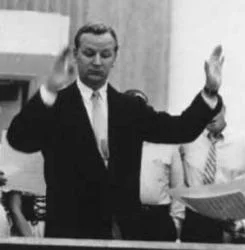
Brian Wilson
- Early Life and Musical Gifts
- The Beach Boys’ Rise
- Pet Sounds and Smile
- Struggles and a Return to Music
- Final Years and Legacy
Brian Wilson reshaped American pop music by treating the recording studio as an instrument. As the Beach Boys’ principal songwriter, arranger, and producer, he expanded the group’s bright California sound into intricate, emotionally searching records such as Pet Sounds. His career brought extraordinary musical acclaim alongside long periods of mental illness, substance use, and retreat from public life. After a late-career return to performance and the completion of his long-delayed Smile project, he died in 2025 at age 82.
Early Life and Musical Gifts
Brian Douglas Wilson was born on June 20, 1942, in Inglewood, California, and grew up in nearby Hawthorne. He was the eldest son of Murry Wilson, a machinist and aspiring songwriter, and Audree Wilson. His younger brothers, Dennis and Carl, would become his bandmates. From an early age, Brian showed a strong ear for harmony and learned to play piano, arranging vocal parts for family members and friends.
Wilson later described his father as physically and emotionally abusive, and biographers have documented the difficult atmosphere at home. Music offered both a source of connection and a path out. In 1961, Brian, Dennis, and Carl formed a group with their cousin Mike Love and friend Al Jardine. Initially called the Pendletones, they became the Beach Boys, named for a sound and image that captured the surf culture of Southern California.
The Beach Boys’ Rise
The band’s early songs paired tight vocal harmonies with lyrics about surfing, cars, and teenage life. “Surfin’,” “Surfin’ U.S.A.,” and “I Get Around” helped make the group a national success. Wilson’s role extended well beyond singing: he wrote songs, arranged the harmonies, and oversaw recordings, often building the instrumental tracks with Los Angeles session musicians before the band added its vocals.
By 1964, touring had become emotionally overwhelming. After experiencing a breakdown during a flight, Wilson stopped touring with the group and concentrated on writing and recording. The move freed him to pursue more ambitious studio work, though it also left him increasingly isolated from the band’s live life.
Pet Sounds and Smile
Wilson’s work with lyricist Tony Asher culminated in Pet Sounds, released in 1966. The album used unconventional combinations of instruments, layered vocals, and carefully arranged studio effects to create a cohesive, intimate sound. Songs such as “Wouldn’t It Be Nice” and “God Only Knows” revealed a more vulnerable side than the group’s early hits. Though its initial American commercial reception was more modest than its later stature might suggest, the album was celebrated by musicians and critics and became a landmark in popular music.
Wilson next began an expansive project with lyricist Van Dyke Parks, eventually known as Smile. The sessions generated ambitious material, including “Good Vibrations,” which became a major hit, but the full album was never completed in the 1960s. Internal disagreements, pressure from the record company, and Wilson’s worsening mental health all contributed to the project’s collapse. Some songs and fragments appeared on later Beach Boys records, while Smile itself became a celebrated unfinished work.
Struggles and a Return to Music
In the years that followed, Wilson’s mental health and substance use affected his work and personal life. He experienced depression and periods of withdrawal, and later spoke publicly about voices and other psychiatric symptoms. In the 1980s he began treatment with psychologist Eugene Landy, whose intensive involvement in Wilson’s personal and professional life became controversial. Wilson’s family challenged Landy’s influence in court. In 1991, a settlement required a separation between the two and led to the appointment of an independent conservator with limited authority.
Wilson gradually returned to recording and performing. His 1988 solo album, Brian Wilson, marked an important step back into public music-making. In 1995 he married Melinda Ledbetter, who became a close partner and supported his later career. Together they adopted five children; Wilson also had two daughters, Carnie and Wendy, with his first wife, Marilyn Rovell. He and the Beach Boys were inducted into the Rock & Roll Hall of Fame in 1988, and he entered the Songwriters Hall of Fame in 2000.
In 2004, Wilson and a group of musicians completed and performed Brian Wilson Presents Smile, bringing the long-shelved project to the stage and recording studio decades after its original sessions. The performance was widely acclaimed and gave listeners a chance to encounter the work as a complete piece. The Beach Boys’ original Smile recordings were later collected in The Smile Sessions, which won a Grammy for Best Historical Album. Wilson continued to tour and release solo work, including recordings that revisited George Gershwin and his own Beach Boys catalog.
Final Years and Legacy
Ledbetter died in January 2024. After her death, Wilson’s family and longtime associates sought a conservatorship. A Los Angeles judge approved it in May 2024 after reviewing medical evidence that Wilson had a major neurocognitive disorder. He remained under care until his death on June 11, 2025. His family announced his death but did not disclose a cause.
Wilson’s achievements were recognized with two Grammy Awards as a solo artist, a Kennedy Center Honor, and the Beach Boys’ Grammy Lifetime Achievement Award. His influence reaches far beyond any list of honors: generations of songwriters and producers have studied the way he combined melody, harmony, and studio experimentation. Behind the sunlit image of the Beach Boys was an artist who made room in pop music for longing, uncertainty, and emotional complexity.