Busshi Tori
 Japan
Tori Busshi, also known as Kuratsukuri no Tori, was a Buddhist sculptor active in Japan in the early seventh century. His name is closely associated with two foundational works of early Japanese Buddhist art: the Great Buddha at Asuka-dera and the gilt-bronze Shaka Triad at Hōryū-ji. Though little is known about his personal life, surviving sculpture and historical records place him at the center of a new artistic tradition taking shape in Japan.
A Sculptor in Asuka Japan
Tori worked during the Asuka period, when Buddhism was becoming established in Japan and ruling families sponsored new temples and images. The term “busshi” means Buddhist image maker or sculptor; it is an occupational title rather than simply a personal name. Tori came from the Kuratsukuri lineage, a family associated with saddle making and metalwork. Historical accounts connect his family to immigrants from the Asian mainland, though sources and later scholarship do not agree on whether their origins lay in China or the Korean peninsula.
The spread of Buddhism brought new demand for images of the Buddha and bodhisattvas. These works required skilled artisans able to cast bronze, apply gilding, and create the elaborate halos, pedestals, and ornamental details that turned a sculpture into a focus of worship. Tori received commissions from powerful patrons, including the Soga clan and Prince Shōtoku, at a time when Buddhist art and temple building were closely tied to court life.
The Asuka-dera Great Buddha
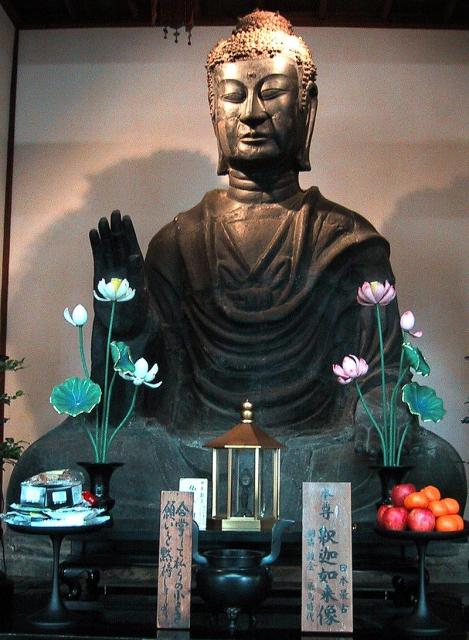
One of Tori’s earliest major commissions was a large bronze image of Shakyamuni Buddha for Asuka-dera, a temple founded by the Soga leader Soga no Umako. The project began around 605, and accounts give different dates for the image’s completion, most often 606 or 609. The surviving statue, known as the Asuka Daibutsu, has been damaged and extensively repaired over the centuries, making it difficult to reconstruct its original appearance. It nevertheless remains an important witness to the earliest monumental Buddhist sculpture in Japan and to Tori’s role in its creation.
The Hōryū-ji Shaka Triad
Tori’s most securely attributed work is the Shaka Triad in the Golden Hall of Hōryū-ji. Completed in 623, the gilt-bronze group shows Shakyamuni seated between two attendant bodhisattvas, Yakuō and Yakujō. An inscription on the back of the halo describes the circumstances of its creation and names Tori as its maker.
The commission was made in prayer for Prince Shōtoku and members of his household after illness and death had struck the family. The central Buddha was intended to resemble the prince and to aid his recovery; Shōtoku died in 622, before the sculpture was complete. The triad was then dedicated in his memory. It remains in Hōryū-ji, where its inscription provides one of the rare links between a named early Japanese sculptor, a surviving work, and a specific date.
Tori Style and Legacy
The Shaka Triad displays the features associated with the Tori style: a formal, front-facing arrangement, strong symmetry, and finely patterned drapery. Its compact forms and restrained expressions reflect artistic traditions that reached Japan from continental East Asia, including Chinese and Korean Buddhist sculpture. These features were adapted to the needs of Japan’s new temples and helped establish an early visual language for Buddhist images.
Tori’s career is only partly visible in the surviving record. His birth and death dates are unknown, and little is documented about his workshop or later life. What remains is enough to make him one of the earliest Japanese sculptors whose name can be connected with a major surviving work. Through the Asuka-dera Buddha and especially the Hōryū-ji triad, Tori helped shape the beginnings of Japanese Buddhist sculpture and the artistic culture of the Asuka court.


