Carlos Ibanez del Campo
 Chile
Chile- Carlos Ibañez del Campo: A Chilean Military and Political Leader
- The Presidential Elections and Dictatorship
- Social Reforms and Repression
- Return to Chile and Political Career
- Second Presidential Term
Carlos Ibañez del Campo: A Chilean Military and Political Leader
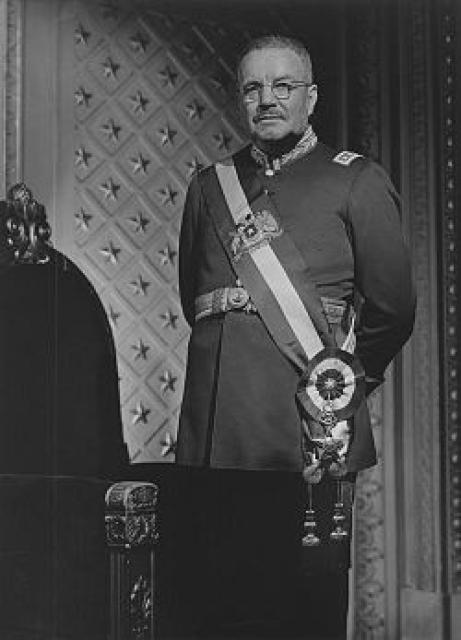
Carlos Ibañez del Campo was a Chilean military and political leader, serving as the President of Chile from 1927 to 1931 and again from 1952 to 1958. He rose to prominence in January 1925 when he led a military coup alongside Marmaduke Grove, reinstating the previously ousted Arturo Alessandri as president. Ibañez assumed the role of Minister of War in Alessandri's government, and his power increased under President Emiliano Figueroa. He became the Minister of Interior and forced Figueroa to resign in February 1927, establishing a military dictatorship and assuming the position of Vice President.
The Presidential Elections and Dictatorship
In the presidential elections that followed Figueroa's resignation, Ibañez's only opponent was communist Elias Lafferte, who had been exiled to a remote southern island and was unable to participate in the campaign. The Communist Party of Chile was declared illegal in March 1927, and traditional political parties did not participate in the elections. As a result, Ibañez won with 98% of the votes on May 22, 1927. He ruled as president from May 1927 to July 1931, using presidential decrees to govern and freely changing deputies. He actively arrested political opponents, earning him the nickname "The Mussolini of the New World." Despite his dictatorial methods, Ibañez portrayed himself as a champion of the common people and an opponent of the oligarchy, combining his authoritarian rule with social demagoguery.
Social Reforms and Repression
Ibañez established pro-government trade unions, such as the Republican Confederation of Civic Action, and arrested the leaders of the country's largest labor center, FOCH, in 1927-1928. FOCH and anarchist-syndicalist organizations were also declared illegal. Ibañez secured loans from the United States and initiated an extensive public works program. However, due to widespread unrest, he fled the country in July 1931. He lived in exile, primarily in Argentina, from 1931 to 1937.
Return to Chile and Political Career
Upon his return to Chile, Ibañez was nominated for the presidency in 1938. He once again presented himself as a representative of the common people, promising significant social reforms. His supporters formed the National Liberation Alliance, which challenged the Popular Front. On September 4, 1938, 40,000 Ibañez supporters held a demonstration in Santiago. The following day, they seized the university and a workers' insurance bank, both located near the presidential palace. One of the presidential residence guards was killed in the incident. However, the Carabineros quickly suppressed the uprising and arrested Ibañez. Sixty captured rebels were executed on the spot. Ibañez withdrew his candidacy and urged his supporters to vote for the Popular Front.
In August 1939, Ibañez participated in a military uprising against the government of the Popular Front and was subsequently arrested. In 1942, he ran for president once again and received the support of the Conservative and Liberal parties, in addition to his organized National Movement. Ibañez finished second with 44% of the votes, losing to his close friend Juan Antonio Rios of the Democratic Alliance. From 1949, he served as a senator.
Second Presidential Term
From November 1952 to November 1958, Ibañez served as president once again. In the 1952 presidential elections, he secured first place with 46.8% of the votes and was elected by the National Congress, which consisted of the two candidates with the most votes. Despite being 75 years old at the time, Ibañez promised to implement agrarian reform and revise unequal agreements with the United States. He chose a broom as his symbol, vowing to sweep all corrupt representatives of the oligarchy from power. He positioned himself as a follower of Argentina's popular president Juan Peron and presented himself as an "anti-party" candidate, criticizing the country's main bourgeois parties (conservatives, liberals, and radicals). One of the two socialist parties in Chile supported his candidacy.