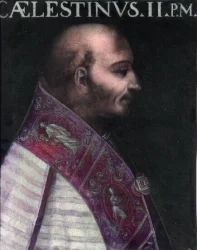
Celestine II
Celestine II was pope for a little more than five months, from September 1143 until his death in March 1144. His short pontificate followed years of schism and political conflict within the Western Church. He is remembered for his efforts to restore relations with France and for continuing the papacy’s struggle to maintain authority amid rival claims in Italy and Europe.
From Cardinal to Pope
Born Guido di Castello in Città di Castello in Umbria, Celestine had served as a cardinal and papal envoy before his election. During the schism that began in 1130, he supported Pope Innocent II, who faced the rival claim of Antipope Anacletus II. Guido remained part of Innocent’s circle through the years of conflict and diplomacy, including efforts to persuade rulers such as Roger II of Sicily to recognize the pope.
After Innocent II died, the cardinals elected Guido on 25 September 1143. He took the name Celestine II. His election came after a long period of instability in Rome, and he inherited a church still negotiating with European rulers over appointments, jurisdiction, and the limits of royal authority.
Relations with France and the Papacy’s Rivals
One of Celestine’s first notable actions was to lift the interdict imposed on France under his predecessor. King Louis VII had opposed the appointment of Pierre de la Châtre as archbishop of Bourges, and the dispute had placed the kingdom under ecclesiastical sanctions. Once the king accepted the papally supported appointment, Celestine ended the interdict, easing a serious conflict between Rome and the French crown.
Celestine’s wider policy continued Innocent II’s effort to consolidate papal legitimacy after the schism. He worked within a political landscape where the papacy’s authority depended on a shifting network of alliances with kings, emperors, and Italian powers. Bernard of Clairvaux, an influential abbot and churchman, remained a key advocate of Innocent’s cause and was associated with the diplomatic efforts of the period.
A Brief Legacy
Celestine’s pontificate ended with his death in Rome on 8 March 1144. His successor, Lucius II, inherited the unresolved conflict with Roger II of Sicily and the challenges of securing the papacy’s position in central Italy. Celestine’s short time in office left little opportunity for a broad program of reform.
His reign is best understood as a transitional moment after a prolonged schism. By easing the conflict with France and maintaining the papacy’s claims in a divided political world, Celestine helped steady the Church before the next series of confrontations under his successor.