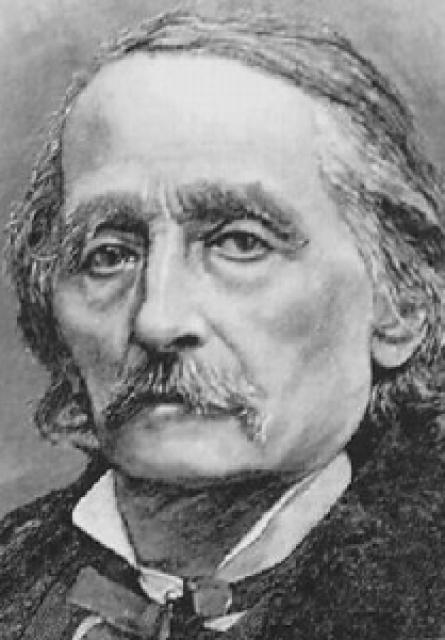
Cesare Cantu
 Italy
ItalyBiography of Cesare Cantu
Cesare Cantu, an Italian historian, politician, and writer, was born in 1804 in Brivio, Lombardy. He began his career as a teacher and his first literary work was the romantic poem "Algiso, o la Lega Lombarda," which was published in 1828 and later reprinted in Milan in 1876. In 1829, Cantu published "Storia della città e della diocesi di Como," which marked the beginning of his career as a writer.
During this period, Cantu faced financial difficulties due to the death of his father, and he had to support his large family. He worked as a teacher while also seizing any opportunity to earn extra income. He was deeply influenced by the spirit of romanticism and his passionate literary activities and anti-Austrian views soon caught the attention of the police. In 1833, Cantu was arrested and implicated in a major political scandal. Although he was not allowed to write in prison, Cantu managed to continue his literary pursuits and wrote the historical novel "Margherita Pusterla" in his cell. This novel, written with pieces of candle wax on scraps of paper, became widely known and brought him true fame.
After a year, Cantu was released from prison and continued to write as he was dismissed from teaching. In 1836, the publisher Giuseppe Pomba commissioned him to write a comprehensive historical work that could appeal to a diverse readership. Cantu's most notable work became the somewhat convoluted but captivating "Storia universale," which was initially published in 35 volumes. The books experienced numerous reprints and were translated into several languages, including French, English, German, and Polish. Cantu later wrote a continuation to the "Storia universale," and these works ultimately brought him financial prosperity and widespread recognition.
Some argue that Cantu's books are excessively moralistic and not historically accurate, as they prioritize religious postulates. Nevertheless, this did not diminish their popularity. In addition to the "Storia universale," Cesare Cantu is known for his books "Gli eretici d'Italia" (1873), "Cronistoria dell'Indipendenza italiana" (1872-1877), and "Il Conciliatore e i carbonari" (1878). He also wrote about Lord Byron, Victor Hugo, and German literature.
From 1861 to 1867, Cantu returned to teaching and served as a deputy in the parliament. He managed the state archives in Milan and served as the president of the Lombard historical society. Cantu also founded the Lombard archives. He passed away on March 15, 1895.
In addition to his literary works, Cesare Cantu is known for his numerous famous phrases and aphorisms. One of his quotes is, "False learning is worse than ignorance. Ignorance is a bare field that can be cultivated and sown; false learning is a field overgrown with weeds that are nearly impossible to weed out."