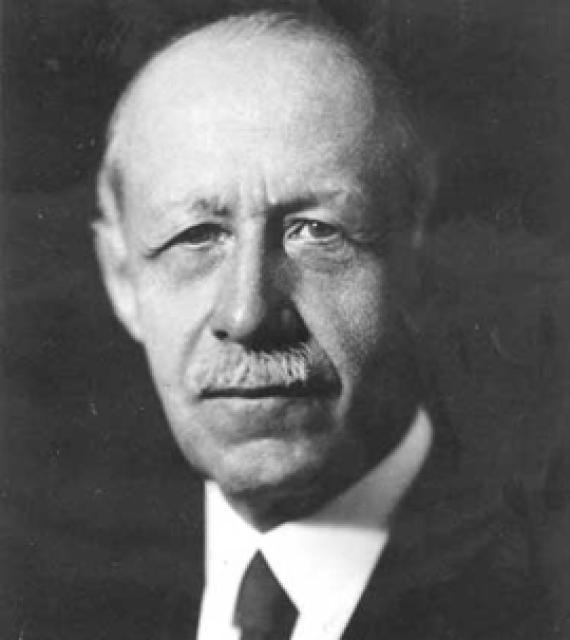
Charles Abram Ellwood
 USA
Charles Abram Ellwood (January 20, 1873–September 25, 1946) was an American sociologist who helped establish social psychology as a central area of sociological study. A professor at the University of Missouri for three decades and later chair of sociology at Duke University, he argued that scholarship should do more than describe society: it should help people understand and address social problems. He also became a prominent public critic of racial prejudice and lynching.
Education and the new social science
Ellwood was born on a family farm near Ogdensburg, New York. He studied at Cornell University, graduating in 1896, and continued at the University of Chicago, where he earned a doctorate in sociology and philosophy in 1899. His dissertation, “Some Prolegomena to Social Psychology,” appeared in the American Journal of Sociology. He also studied at the University of Berlin, an experience that widened his academic outlook at a time when sociology was taking shape as a distinct discipline.
After a year teaching at the University of Nebraska, Ellwood joined the University of Missouri in 1900 as a professor of sociology. His scholarship drew on psychology, philosophy, religion and social research. He wanted sociology to be scientific, but he also believed that facts should inform social reform. His textbooks and lectures brought that approach to a broad audience. Sociology and Modern Social Problems (1910), Sociology in Its Psychological Aspects (1912) and The Social Problem: A Constructive Analysis (1915) helped make social problems a regular subject of university study. The University of Missouri has credited his social-problems textbook with selling more than 200,000 copies.
Research with a reform purpose
Ellwood’s work examined the forces shaping group behavior, social change and conflict. In An Introduction to Social Psychology (1917), he explored how people and societies influence one another. He served as an editor for leading academic journals and helped build the institutions of the young discipline. In 1924, he was elected president of the American Sociological Association.
His social philosophy was rooted in moral and religious convictions. In The Reconstruction of Religion (1922) and The World’s Need of Christ (1940), he argued that religious teaching could contribute to solutions for humanity’s problems. That position placed him at odds with scholars who wanted sociology to remain detached from moral judgment. Ellwood instead saw education and sociological knowledge as tools that could guide social development.
He applied those convictions publicly. After the 1923 lynching of a Black man in Columbia, Missouri, Ellwood spoke out against the killing and the community’s failure to prevent it. His criticism drew local anger and threats from the Ku Klux Klan. Ellwood also challenged racial essentialism, arguing that there were no “pure” races. His position and the research of colleagues and students put him at odds with popular racial hierarchies and the misuse of intelligence testing to claim that some groups were inherently superior.
Later years and legacy
Ellwood moved to Duke University in 1930, where he chaired the sociology department until 1946 and became professor emeritus in 1944. He continued to publish on social psychology and methods in sociology, including Methods in Sociology (1933). He died at his home in Durham, North Carolina, aged 73. His wife was Ida Breckinridge, and they had a son, Walter.
Ellwood’s legacy rests on his effort to connect sociological study with public life. He helped train generations of students, gave social psychology a durable place in the discipline and used his standing to challenge racial injustice. His career reflects an early American sociology still deciding what it should be: a detached science, a guide to social reform, or—in Ellwood’s view—both at once.


