Charles de Coulomb
 France
Biography of Charles de Coulomb
Charles Augustin de Coulomb was a French engineer and physicist, and one of the founders of electrostatics. He was born on June 14, 1736, in Angoulême, in a prosperous noble family. His father was a prominent royal official. Coulomb studied at the prestigious College of Cat-Nation, where he developed a passion for mathematics and wrote several works that earned him membership in the scientific society in Montpellier.
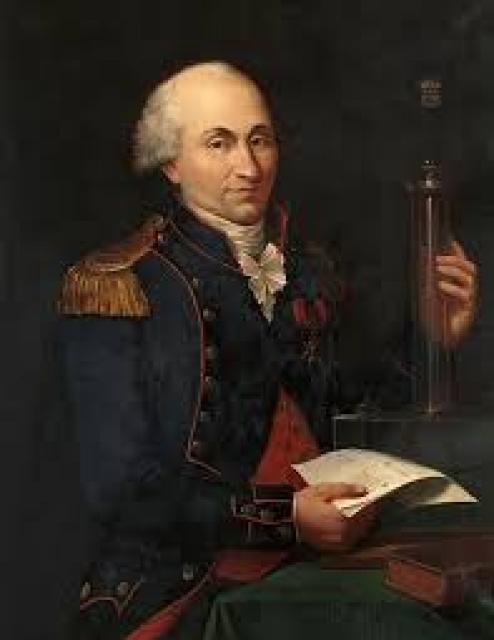
In 1758, Coulomb enrolled in the military school in Mézières, specializing in military engineering, and graduated in 1761 as a first lieutenant, the only one in his class. However, his military career did not go as planned. He was sent to the distant overseas colony of Martinique, where he spent nine years constructing bridges, roads, and fortifications. It was only in 1772 that Coulomb managed to escape this "green hell" and return to France.
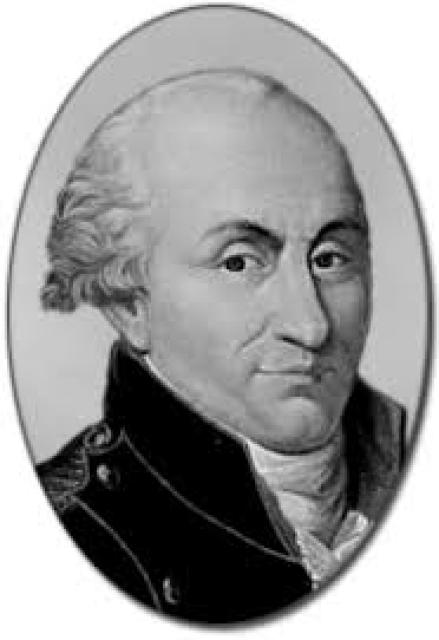
Back in France, Coulomb continued working as a military engineer in Cherbourg, Besançon, and other places, while also pursuing his scientific interests. His primary focus was on mechanics, and his scientific work on architectural calculations led to his election as a corresponding member of the French Academy of Sciences in 1774. He also conducted research on friction forces and proposed the formula for determining frictional force, which is still taught in schools.

In 1781, Coulomb was elected as an academician. During this time, he became known as the "engineer of the king," as many Parisian structures were designed by him. In the 1780s, Coulomb became interested in electrical forces of attraction and repulsion. He wondered if these tiny forces could be measured. Coulomb demonstrated remarkable ingenuity and, in 1784, constructed an instrument for measuring extremely small forces - the torsion balance. Using the torsion balance, he conducted a series of experiments and, in 1785, formulated his famous law: the force of attraction (or repulsion) between charges is directly proportional to the product of their charges and inversely proportional to the square of the distance between them. Coulomb took pride in the fact that the notation for his law resembled Newton's law of universal gravitation, although Newton's law only described attraction.
After Coulomb's death, in 1810, the papers of the English physicist Henry Cavendish were examined, revealing that Cavendish had discovered the law of electrostatics in 1771 but had not published it for unknown reasons. In science, as in history, there is no room for the subjunctive mood. Not publishing it - his own fault. Therefore, the law rightfully bears the name of Charles Coulomb.
During the French Revolution, Coulomb, as a nobleman and officer, was forced to hide in the small town of Blois. When the revolution subsided, the brilliant engineer and scientist once again found himself in demand and continued his work, particularly in the field of magnetism.
In 1802, Coulomb was summoned by Napoleon. Napoleon had a profound admiration for intellectuals and scholars. As an example, he bestowed the title of count and appointed the renowned French mathematician Laplace as a minister. When Laplace failed in his ministerial duties, Napoleon did not blame him but affectionately said, "Go, Laplace, and engage in real business." Coulomb was given the rank of general and a high position as the Inspector General by Napoleon. In his final years, Coulomb lived in Paris, surrounded by respect and fame.
Charles de Coulomb passed away on August 23, 1806, leaving behind a significant legacy in the field of physics and engineering. His contributions to electrostatics and mechanics continue to be studied and celebrated to this day.