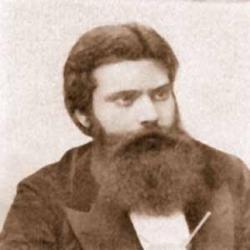
Charles Labarte
 France
Law and a New Scholarly Path
Charles Jules Labarte, usually known by the name Jules Labarte, was born in Paris on July 23, 1797. He studied law at the Collège Louis-le-Grand and received his law degree in 1819. In 1824 he succeeded his father as a legal officer, or avoué, at the Seine court. For more than a decade, his professional life followed the path of a Paris lawyer.
His interests shifted toward the material history of art through his connection to the collector Louis-Fidel Debruge-Duménil, whose daughter Joséphine he married in 1823. After Debruge-Duménil’s death, Labarte took responsibility for organizing and presenting the collection, which included medieval and Renaissance works. In 1835 he left legal practice to devote himself to archaeology and art history.
Studying Objects and Techniques
Labarte approached art through close examination of objects as well as written records. He traveled to museums, churches, exhibitions and private collections across France and elsewhere in Europe, studying works in their historical settings. His interests ranged from medieval goldsmithing and enameling to ivory, furniture, stained glass and the relationship between Byzantine art and western Europe.
His first major publication, a 1847 catalogue of the Debruge-Duménil collection, opened with an extensive historical introduction. He developed this research into Histoire des arts industriels au Moyen Âge et à l’époque de la Renaissance, published in the 1860s and later revised. The richly illustrated study traced the materials, methods and uses of decorative arts across centuries. It became an influential reference for scholarship on medieval and Renaissance art.
Labarte also examined the art and ceremonial spaces of Byzantium. In Le Palais impérial de Constantinople et ses abords, he reconstructed the tenth-century imperial palace and its surroundings from historical texts. His arguments sometimes gave Byzantine influence an expansive reach, but his work helped establish Byzantine objects and techniques as important subjects for the history of European art.
Recognition and Legacy
Alongside his books, Labarte published studies of enamel painting and edited the 1879 inventory of the possessions of Charles V of France. His research earned awards from the Académie des Inscriptions et Belles-Lettres, including recognition for Histoire des arts industriels in 1868. He was elected a member of the academy in 1871 and was made a chevalier of the Legion of Honour.
Labarte died in Boulogne-sur-Mer on August 14, 1880. His lasting contribution was to treat decorative objects as historical evidence: their materials, workmanship, imagery and recorded uses could illuminate both artistic practice and everyday life. By combining direct study of artifacts with archival research, he helped give the history of medieval and Renaissance applied arts a more systematic foundation.