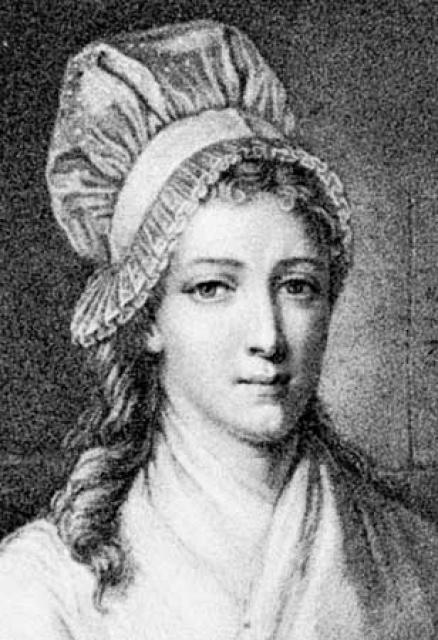
Charlotte Corday
 France
- Charlotte Corday: A Biography
- Education and Maturity
- The Influence of the Revolution
- The Assassination of Marat
- The Assassination and Aftermath
- The Execution and Legacy
Charlotte Corday: A Biography
Early Life and EducationCharlotte Corday was born into a noble family in France. She was the daughter of Jacques François Alexis de Corday d'Armont and Marie Jacqueline de Gonthier de Menival, and the great-granddaughter of the famous playwright Pierre Corneille. Corday came from an ancient aristocratic family, but her father, being the third son, did not inherit the family fortune. He served in the army for a while before retiring and becoming a farmer. Corday spent her childhood on her family's farm in Ronceray and received her early education from her uncle, the local priest Charles Amédée. Her uncle introduced her to the works of their famous ancestor, Corneille, and provided her with a basic education.
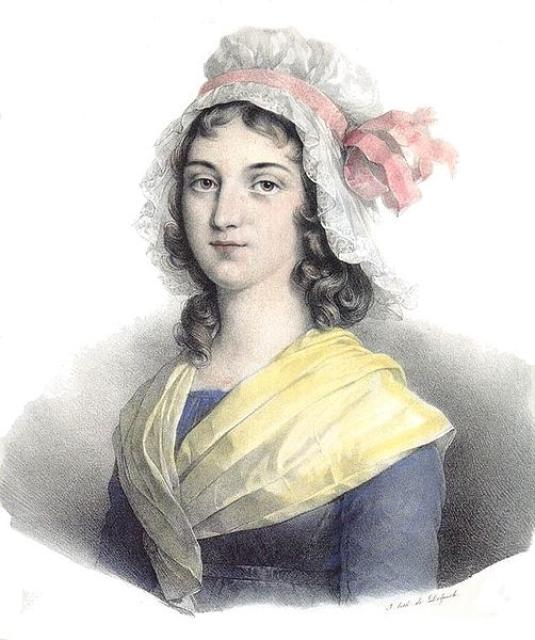
Education and Maturity
When Corday was fourteen years old, her mother died during childbirth. Her father attempted to enroll Corday and her younger sister Éleonore in the prestigious boarding school of Saint-Cyr, but they were denied entry because their family did not belong to the noble families who had distinguished themselves in royal service. Instead, they were sent to the Benedictine Abbey of the Holy Trinity in Caen, where their distant relative Madame Pantecoulant served as a teacher. In the abbey, Corday was allowed to read not only spiritual books but also works by Montesquieu, Rousseau, and Abbé Raynal. However, due to anti-clerical decrees in 1790, the abbey was closed, and Corday returned to her father's home. They initially lived in Menil-Imbere, but due to a dispute with a local poacher, they moved to Argentan. In June 1791, Corday settled in Caen with her cousin Madame de Béthune.
The Influence of the Revolution
Corday's close friend Amanda Luaye recalled that Corday had no interest in marriage and her thoughts were focused on different matters. Corday was an avid reader, devouring newspapers and brochures of various political ideologies. Luaye remembered that Corday openly refused to drink a toast to the king, stating that a weak king could not be good for his people. The execution of Louis XVI deeply affected Corday, and she mourned not only the king but also the state of France. She wrote to Luaye, expressing her horror and anger at the events unfolding in their country. Corday became increasingly disillusioned with the revolution and its course.
The Assassination of Marat
In June 1793, Corday learned that the Girondist deputies were in Caen. The Intendance Mansion on Rue des Carmes, where they were staying, became the center of opposition to the regime. Corday met with one of the deputies, Barbaroux, and appealed for help in securing a pension for her former fellow nun, Alexandrine de Forbin, who had emigrated to Switzerland. This was a pretext for Corday to travel to Paris, and she obtained a passport in April. Corday requested a recommendation from Barbaroux and offered to deliver brochures from the Girondists to their friends in the capital. On the evening of July 8, Corday received a letter from Barbaroux, a letter of recommendation to the deputy Duperret and several brochures. In her response, she promised to write to Barbaroux from Paris. Taking the letter from Barbaroux, Corday risked arrest on her journey to Paris, as the Convention had just declared the Girondists traitors. Corday burned all her papers before leaving and left a farewell letter to her father, stating that she was going to England. On July 11, Corday arrived in Paris and stayed at the Hotel Providence on Rue Vieille-Augustins. She met with Duperret that evening, explained her purpose, and agreed to meet him the next morning. However, Corday unexpectedly told him to leave the city, as it was no longer safe for him. The following day, Corday met Duperret again, but he couldn't help her as his papers, like those of other Girondist deputies, had been sealed. Corday advised him to flee, but Duperret was determined to stay in the Convention, where he had been elected by the people. On the morning of July 13, 1793, Corday went to the Palais-Royal and bought a kitchen knife from a shop. She then took a carriage to Marat's house on Rue des Cordeliers. Corday tried to gain entry to see Marat, claiming that she had important information about a conspiracy in Caen. However, Marat's wife, Simone Evrard, did not let her in. Corday returned to her hotel and wrote a letter to Marat, requesting a meeting after noon but forgetting to include her return address.
The Assassination and Aftermath
Not receiving a response, Corday wrote a third note and returned to Rue des Cordeliers in the evening. This time, she successfully reached Marat, who was sitting in his bathtub, seeking relief for his skin condition. Corday informed him about the Girondist deputies who had fled to Normandy and stabbed him with her knife after he said he would send them all to the guillotine. Corday was immediately apprehended at the scene. She wrote to Barbaroux from prison, expressing her belief that she would die immediately and thanking him for protecting her from the furious crowd. Corday was interrogated twice, first at Marat's house and then at the Abbey Prison. She was placed in a cell previously occupied by Madame Roland and later by Brissot. Two gendarmes guarded her around the clock. When Corday learned that Loys Duperré and Bishop Fauchet were arrested as her accomplices, she wrote a letter denying their involvement. On July 16, Corday was transferred to the Conciergerie. On the morning of July 17, her trial took place before the Revolutionary Tribunal under the chairmanship of Montane and the presence of the public prosecutor Fouquier-Tinville. Corday chose Gustave Doulcet as her official defender, but he received her letter only after her execution. During the trial, Corday maintained her composure and asserted that she had acted alone. After hearing witness testimonies and Corday's interrogation, Fouquier-Tinville read her letters to Barbaroux and her father, which she had written in prison. The public prosecutor demanded the death penalty for Corday. During his speech, Corday's defender, Chauveau-Lagarde, was instructed by the jury to remain silent and the court president declared Corday insane. Corday confirmed her guilt and was sentenced to death unanimously. As she left the courtroom, Corday thanked Chauveau-Lagarde for his courage in defending her.
The Execution and Legacy
While waiting for her execution, Corday posed for the artist Goyet, who had started painting her portrait during her trial. She engaged in conversations with him on various topics. Before parting, she gave Goyet a lock of her hair as a gift. Corday refused to receive the last sacrament. Wearing the red shirt reserved for parricides, Corday proclaimed, "The garment of death in which one enters immortality." According to the executioner Sanson, Corday showed unparalleled courage, reminiscent of the execution of Damiens in 1766. She stood in the cart throughout the journey to the execution site, refusing to sit. When Sanson covered the guillotine to shield Corday from the view, she asked him to step aside as she had never seen the device before. Corday was executed at half-past seven in the evening on July 17, 1793, in the Place de la Révolution. Some witnesses claimed that a carpenter assisting in the construction of the guillotine took her severed head and struck her face. The newspaper "Revolutions de Paris" condemned this act. Sanson felt compelled to publish a statement in the newspaper, clarifying that the carpenter, not himself or his assistant, had committed the act out of unprecedented enthusiasm. Corday's body underwent a medical examination to confirm her virginity. She was buried in the Madelaine Cemetery in ditch number 5. During the Restoration, the cemetery was liquidated. In July 1793, representatives of the municipality of Argentan searched the house of Corday's father and interrogated him. In October 1793, he was arrested along with his elderly parents. His grandparents were released in August 1794, and his father was released in February 1795. He was forced to emigrate, and he settled in Spain, where his eldest son, Jacques François Alexis, was living. Jacques François Alexis died in Barcelona on June 27, 1798. Corday's uncle, Pierre Jacques de Corday, and her younger brother, Charles Jacques François, also emigrated and participated in a royalist landing on the Quiberon Peninsula on June 27, 1795. They were captured by the republicans and executed. Marat was declared a victim of the Girondists who conspired with the royalists. Vernou, upon hearing the news from Paris, exclaimed, "She [Corday] destroys us but teaches us how to die!" Augustin Robespierre hoped that Marat's death "thanks to the circumstances accompanying it" would be beneficial to the republic. According to some opinions, Corday provided the opportunity to transform Marat from a prophet into a martyr and encouraged the supporters of the Terror to exterminate their political opponents. Madame Roland, imprisoned in Saint-Pélagie, regretted that Marat was killed rather than "the one who is much more guilty" (Robespierre). According to Louis Blanc, Corday, who claimed to have killed one man to save a hundred thousand, was the most consistent disciple of Marat, bringing his principle to its logical conclusion - sacrificing a few for the well-being of the nation. Corday's assassination of Marat sparked a spontaneous cult of worship for him. Throughout the country, churches displayed his bust on altars draped with tricolor cloth. He was compared to Jesus, and streets, squares, and even cities were renamed in his honor. After a grand and lengthy ceremony, he was buried in the Cordeliers' Garden, and two days later, his heart was solemnly transferred to the Cordeliers Club. The publisher of the "Bulletin of the Revolutionary Tribunal" requested to publish Corday's final letters and her "Appeal," but the Committee of Public Safety denied the request, considering it unnecessary to draw attention to a woman who already aroused great interest from her detractors. Both opponents of the French Revolution and revolutionaries who were enemies of the Jacobins portrayed Corday as an immoral person, an old maid with a head "stuffed with all sorts of books," a proud woman without principles, seeking fame like Herostratus. Adam Lux, a deputy from Mainz and a doctor of philosophy, who was deeply affected by the defeat of the Gironde and decided to die in protest against the impending dictatorship, was inspired by Corday's death. Lux openly admitted his authorship, intending to die on the same scaffold as Corday. He was arrested, sentenced to death for "insulting the sovereign people," and guillotined on November 4, 1793. Lerua, one of the jurors of the Revolutionary Tribunal, lamented that condemned individuals imitated Corday in demonstrating their courage on the scaffold. He wrote, "I would order them to be bled before their execution to deprive them of the strength to behave so worthily." Corday's personality was celebrated by opponents of the French Revolution as well as by propaganda under regimes hostile to the revolution, such as the Restoration and the Second Empire. André Chénier wrote an ode in honor of Charlotte Corday. Pushkin, along with some of the Decembrists, who held negative views of Jacobin terror, referred to Corday as the "Eumenides maiden" (the goddess of vengeance), who caught the "apostle of destruction." In the 2007 film "Charlotte Corday," directed by Henri Helman, Emily Dekon portrayed the title role.


