
Charlotte Gilman
 USA
USA- Charlotte Perkins Gilman: A Feminist and Social Reformer
- Early Life and Education
- Marriage, Motherhood, and Aftermath
- Later Life and Legacy
Charlotte Perkins Gilman: A Feminist and Social Reformer
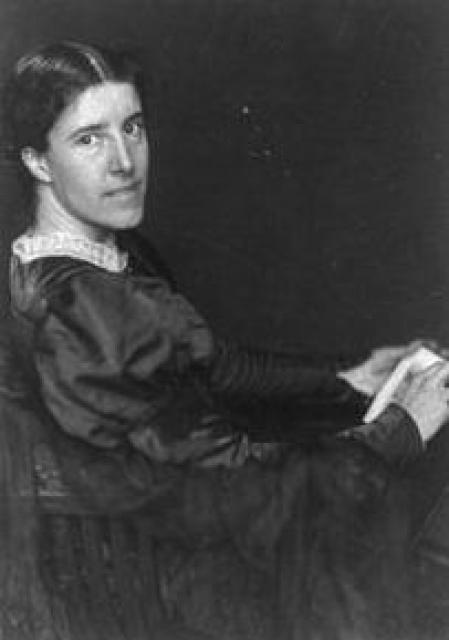
Charlotte Perkins Gilman was an American feminist, sociologist, novelist, short-story writer, poet, literary critic, teacher, and social reformer. She was an influential feminist figure, serving as an example for future generations of feminists due to her unconventional lifestyle and groundbreaking ideas. Her most memorable work, the semi-autobiographical short story "The Yellow Wallpaper," was written after her struggle with postpartum psychosis.
Early Life and Education
Charlotte Perkins Gilman was born on July 3, 1860, in Hartford, Connecticut, to Mary Perkins and Frederick Beecher Perkins. She had only one brother, Thomas Adie, who was 14 months older than her. Mary heeded a doctor's advice that further pregnancies could lead to her death, and she did not have any more children. When Charlotte was a child, her father abandoned the family, leaving her mother and children in poverty. At the age of five, Charlotte began teaching herself to read as her mother was ill. Despite her mother's lack of affection towards her children and her efforts to shield them from "heartache," Charlotte's love for reading persisted. Her book-loving father, who reconnected with her several years later, provided her with a list of books he believed she should read.

Charlotte attended multiple public schools, impressing her teachers with her intellect and breadth of knowledge, but disappointing them upon discovering her poverty. Her favorite subject was natural philosophy, particularly the branch that would later become known as physics.

Marriage, Motherhood, and Aftermath
In 1884, she married artist Charles Walter Stetson. They had a daughter, Katharine Beecher Stetson, a year later. Charlotte suffered from severe postpartum depression after giving birth. During that time, young mothers with psychological issues were labeled as "hysterical" and their problems were not taken seriously. In 1888, Charlotte made the rare decision to leave her husband in an effort to improve her mental health. The marriage was legally dissolved in 1894.
Charlotte and her daughter moved to Pasadena, California, where she became an activist for several feminist and reformist organizations. Eventually, she sent her daughter to live with her ex-husband and his second wife, Grace Ellery Channing. In her memoir, Charlotte wrote that Grace was just as good of a mother as she was, if not better in some respects. She had a progressive view of parental rights and recognized her ex-husband's right to be with their daughter, and Katharine's right to know and love her father.
Later Life and Legacy
After her mother's death in 1893, Charlotte returned to the East Coast and reconnected with her cousin, Houghton Gilman, a Wall Street lawyer. Their relationship quickly turned romantic, and they married in 1900. Until 1922, the couple lived in New York City. However, Houghton unexpectedly died from a cerebral hemorrhage in 1934, prompting Charlotte to return to Pasadena, where her daughter lived.
In January 1932, Charlotte was diagnosed with breast cancer, and her situation was deemed hopeless. A proponent of euthanasia for the terminally ill, she chose to end her life on August 17, 1935, through a chloroform overdose. In her autobiography and final note, she explained that she chose chloroform over cancer. Charlotte passed away quickly and quietly.
Charlotte Perkins Gilman left a lasting impact on feminist literature and feminist movements, challenging societal norms and advocating for women's rights. Her quote, "There is no female mind. The brain is not an organ of sex. Might as well speak of a female liver," continues to inspire and empower women today.


