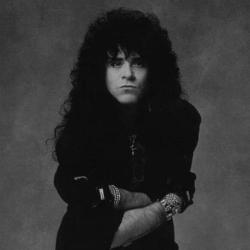
Charly Garcia
 Argentina
Biography of Charlie Garcia
Carlos Alberto Garcia Moreno, known as Charlie Garcia, was born on October 23, 1951 in Buenos Aires, Argentina. He was the eldest son in a wealthy family belonging to the upper middle class. His father taught mathematics and physics at school, while his mother was a producer of musical radio programs, with a special focus on folk music.

Charlie displayed his musical talent and perfect pitch at a young age. At the age of three, he received a toy piano as a gift and soon amazed his mother with his ability to create and play harmonious melodies. This led his mother to enroll him in the prestigious music school Thibaud Piazzini. By the age of 12, he had completed his conservatory education as a full-fledged music teacher.
Charlie's introduction to The Beatles at the age of 13 opened up a new world of British rock music to him. Previously, his imagination was filled with classical and folk music, and the young talent was fascinated by the music of this new genre. In his later years of school, he met Carlos Alberto 'Nito' Mestre, and the two formed a band that eventually became the popular rock group 'Sui Generis'. Their folk-rock music, known for its simplicity and romantic songs, quickly gained popularity among Argentine teenagers. From 1972 to 1975, the band released four albums, establishing Garcia as one of Argentina's most talented rock composers.
However, tension between the band members, including Charlie's wife, who fell in love with Nito Mestre and left him, led to the dissolution of the group. On September 9, 1975, 'Sui Generis' performed two farewell concerts with an audience of 20,000 people, the largest in the history of Argentine rock at that time.
During the mid-70s, between 'Sui Generis' and 'Serú Girán', Charlie formed the band 'La Máquina de Hacer Pájaros', which played symphonic rock and released two albums with complex music and socially conscious lyrics. The group did not gain wide popularity at the time but eventually achieved a cult status.
In 1978, Charlie's new band 'Serú Girán' released their first album, followed by a total of five albums from 1978 to 1982. In 1979, Garcia faced the threat of imprisonment due to the controversial lyrics of his songs, which the authorities considered provocative. Considering the fact that tens of thousands of people had been killed during the military dictatorship, Garcia was incredibly lucky.
Following the fall of the military regime in 1982, Argentina transitioned to democracy, and Charlie Garcia focused on solo projects. He actively recorded, collaborated with numerous Argentine and international musicians, and performed concerts. Although he went through a period of decline in the late 80s and 90s, he managed to overcome the crisis.
In June 2008, Charlie Garcia was hospitalized after a drug and alcohol overdose and a fight in a hotel in Mendoza, Argentina. Following the incident, his friend Palito Ortega took him to his country estate. Garcia spent almost a year communicating with doctors and psychiatrists who supervised his rehabilitation. In August 2009, he released a new song, 'Deberías Saber Porque', marking his full recovery. The song became a hit, and Garcia soon embarked on a tour in Chile and Peru.
On October 23, 2009, the artist celebrated his 58th birthday by performing a concert at Velez Sarfield's Stadium, which became known as the "Underwater Concert" due to a torrential rainstorm. In 2010, Garcia released his final solo album, 'Kill Gil', and he continues to tour, record, and perform on new stages.