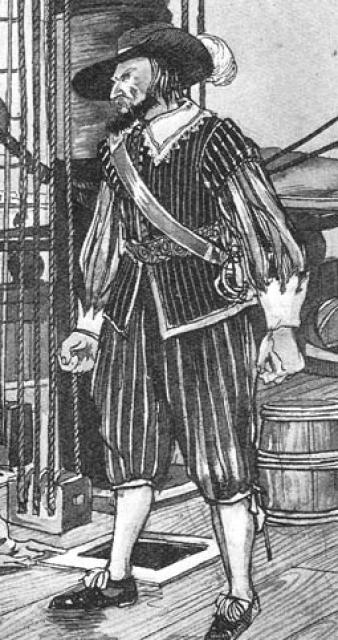
Claes Gerritszoon Compaen
 Netherlands
Biography of Claes Gerritszoon Compaen
Claes Gerritszoon Compaen, a Dutch privateer and merchant of the 17th century, was born in 1587 in Oostzaan, North Holland. It is believed that his father was a member of the opposition aristocracy and opposed Spanish rule. Compaen started his maritime career at a young age and eventually became a successful trader along the Guinea coast.
Using the profits from his voyages, Compaen refitted his ships for capturing Spanish merchant vessels with the permission of the Dutch authorities. He spent a significant amount of time in Oostzaan and Dunkirk, where he quickly seized several enemy ships, including one weighing 200 tons armed with 17 cannons and an 80-man crew. However, the Dutch authorities later released some of the captured ships, causing frustration for Compaen.
In 1621, Compaen set sail with a privateering commission from the Dutch Admiralty to pay off a debt of 8000 guilders to the widow of shipowner Captain Pieter Gerritszoon, from whom he had purchased his ship. He intercepted a fishing vessel loaded with herring and salted fish and used his privateer status to seize it. However, the Dutch Admiralty refused to compensate the fishermen who lost their cargo.
He then captured another ship before taking shelter in Vlissingen from an approaching storm. While in port, he recruited 50 new crew members and began indiscriminately attacking one ship after another, selling his loot in England and along the Barbary Coast. In 1625, Compaen started collaborating with County Clare. He became close friends with the governor, Thomas Wentworth, 1st Earl of Strafford, and freely operated as a pirate in the Irish Sea and English Channel for a while. Later, he appeared in the Mediterranean, selling captured ships and cargoes in Moroccan ports such as Safi, Mogador, and Salé.
During his time in Salé, Compaen sold most of his spoils, over 300 ships, to Simon the Dancer Jr., the son of the famous Dutch pirate Simon the Dancer. However, working with Simon Jr. became unprofitable, leading Compaen to ally with his main competitor, Jan Janszoon. Angered by this turn of events, Simon planned to send his fleet to Salé to defeat Compaen. However, the Dutch corsair learned of the attack in advance, enabling him to achieve victory and seize one of Simon's ships. Simon's flagship suffered severe damage during the raid and was forced to retreat. After the defeat, Simon was forced to leave Salé and seek refuge in the Dutch Republic.
On July 5, 1622, two ships belonging to the Dutch East India Company, the 'Hollandia' and the small yacht 'Grootenbroek', were spotted. According to one version, both ships had fallen behind the main fleet to stock up on limes for sailors suffering from scurvy. Compaen ordered four of his ships to attack the stragglers, but the 'Hollandia', commanded by Captain Wybrant Schram, managed to seriously damage Compaen's flagship. In the clash, 70 of Compaen's men were killed. Despite the damage, Compaen's flagship managed to reach Sierra Leone, where it underwent repairs. The decision was made to release the captured 'Hollandia' and 'Grootenbroek', and in December 1626, the ships arrived in Batavia.
At this point, Compaen began actively seeking forgiveness from his government to return home. It also became increasingly difficult for him to control his large crew, who constantly got drunk and were dissatisfied with the poor food rations. During an attack on Spanish defenders, Compaen's men were forced to retreat, resulting in significant losses. Sailing along the Spanish coast led to a confrontation with the formidable pirate Jacob Collaart, whose forces outnumbered Compaen's fourfold. Despite this, Compaen and his crew managed to survive and escape. In 1626 or 1627, Compaen returned to Salé with newly acquired spoils. He learned that he had been pardoned by the Netherlands and immediately sailed home, four days before the Dutch fleet arrived to detain him. Refusing the request of some members of his crew to stop in Ireland, Compaen arrived in Vliestroom and officially received a pardon from Prince Frederik Hendrik in The Hague.
In his final years, Claes appears to have been less successful, and he eventually died in poverty in his hometown of Oostzaan on February 25, 1660.


