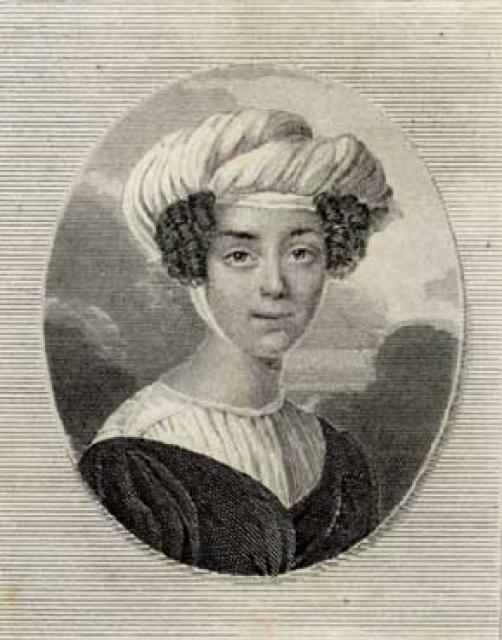
Claire de Duras
 France
The Life of Claire de Duras
Claire de Duras, born Louise-Adélaïde-Philippine de Kéralio, was a French writer whose life was intertwined with political upheaval and literary circles.
Early Life and Emigration
Born to a noble family, Claire's early life was marked by the French Revolution. Her father was guillotined, forcing her to flee France with her mother in 1794. In exile in London, she married and gave birth to a daughter. She returned to her homeland in 1801.
Literary Connections
In 1808, Claire met and befriended René-François Chateaubriand, a pivotal figure in French literature. Through Chateaubriand, she gained entry into literary circles. After the Bourbon Restoration, Claire's husband became close to King Louis XVIII, transforming their home into a hub of Parisian literary life.
Literary Legacy
Despite her initial reluctance, Claire de Duras agreed to publish one of her three novels, "Ourika" (1823), under Chateaubriand's persuasion. "Ourika" depicts the life of a black woman who is freed from slavery and brought to Paris. The novel explores interracial relationships and the impact of societal prejudices. Its importance in French literature was recognized in the latter half of the 20th century.
Another notable work by Claire de Duras is "Olivier" (1822), which examines the experiences of a young man with impotence. The novel's frank portrayal of a taboo subject was unconventional for its time.
Later Years
In addition to her novels, Claire de Duras compiled a book of Louis XIV's thoughts, published in 1827. She also left two unfinished novels, "Le Moine du Saint-Bernard" and "Les Mémoires de Sophie."
Claire de Duras's work continues to resonate with readers, particularly for its exploration of social and racial issues. Her novel "Ourika" has been translated into English and is considered a precursor to John Fowles's "The French Lieutenant's Woman."


