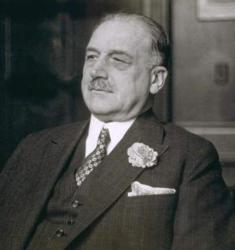
Clara Furse
 Great Britain
Clara Fers: A Biographical Sketch
Clara Fers, a Dutch national, made history on January 24, 2000, when she became the first woman and foreigner to be appointed as the CEO of the London Stock Exchange (LSE), the largest stock exchange in Europe. Fers, who is 43 years old, is a petite and attractive woman with a love for pearls and all things pink. However, behind her delicate appearance lies a strong and determined character. With 21 years of experience in the City, Fers has earned a reputation as a ruthless manager. In her previous role as the CEO of Credit Lyonnais Rouse (CLR), she successfully downsized the company's workforce by 60%. Prior to that, she played a role in the dismissal of the CEO of the London International Financial Futures and Options Exchange (LIFFE), after LIFFE lost a significant market share to its German competitor.
Fers, despite living in Britain for the past 30 years, has an international background. She was born in Montreal in 1957, to a German father who belonged to the famous Siemens family of German industrialists. Her family fled to the Netherlands in the 1930s and later moved to Canada after the war. When Fers was three years old, her father, who was a senior executive at Alcan, was transferred to Colombia. The family then moved to Denmark before finally settling in Britain in 1970. As a result, Fers is fluent in five languages: English, Dutch, French, German, and Spanish.
Fers graduated from the London School of Economics with a degree in Economics. In 1983, immediately after completing her studies, she joined Philips and Drew as a commodities broker. Given the close connection between the global commodities market and futures markets, it was no surprise that she transitioned to working with futures within three years. Within two years of the switch, Fers was appointed as one of the directors of the company. Philips and Drew later merged with Union Bank of Switzerland and then with Swiss Bank, eventually becoming an investment division of UBS. Fers served as the Managing Director of UBS for five years, during which she also held the position of Director of Global Futures and Options Operations.
Fers is known for her strong and tough leadership style. One of her former colleagues at UBS described her as someone who would stand her ground and was not afraid to make enemies. After leaving UBS in 1998, following the merger with SBC Warburg, Fers joined Credit Lyonnais Rouse, the derivatives arm of French bank Credit Lyonnais. During her tenure as CEO of CLR, she successfully integrated the operations of her division with the parent company and implemented a new trading technology within the set time frame and budget. However, her success came at the cost of more than half of CLR's workforce. In December of the previous year, she left Credit Lyonnais Rouse, stating that she was seeking new challenges.
Fers's success in the futures market has brought her a considerable fortune. In addition to her base salary of $275,000 per year as the new CEO of LSE, she will receive a stock options package worth $735,000. She currently resides in London with her husband Richard and their three young children. It is said that she rises from her desk at noon and heads to the gym. Fers believes in maintaining a healthy lifestyle and does not rely on any medications.
While Fers is not the first woman to hold a leadership position at a major exchange, her appointment as the CEO of LSE is significant. Antoinette Hanciker-Ebneter leads the Swiss Exchange, and Maria Dunavolgy serves as the CEO of the Budapest Stock Exchange. Over the past eight years, LSE has had three CEO changes. The previous CEO, Gavin Casey, resigned in September 2000 following the failure of the merger between LSE and Deutsche Borse. LSE almost fell victim to a hostile takeover by Swedish company OM Gruppen, which manages the Stockholm Stock Exchange. Fers's predecessor, Michael Lawrence, left his position in 1996 after serving for about three years. Peter Rawlinson, who held the CEO role until 1993, also resigned before his term ended due to angering shareholders with the failed Taurus project.
The leadership positions at LSE have been considered thankless jobs within the City. Moreover, for many years, the CEO and the Chairman of the Board of LSE were individuals who struggled to work together.
Don Cruickshank, the current Chairman of the Board of LSE, and many other London financiers believe that it is time for the company to break away from its past. Fers's appointment is intended to bring a fresh perspective to the venerable institution. She is viewed as an excellent professional who can assert her ideas and is not constrained by purely British biases, making her ready for international collaboration, as characterized by one of her former colleagues at a London bank.
Cruickshank, who himself came to the position of Chairman of the Board of LSE from outside the exchange community, decided to choose an "outsider who is not entirely an outsider," as one of Fers's former colleagues at UBS Warburg described her. Prior to her appointment at LSE, Fers spent many years specializing in derivatives operations, eventually becoming the Deputy Chairman of the London International Financial Futures and Options Exchange (LIFFE).
Fers is not associated with the interests of major banks such as Merrill Lynch, Goldman Sachs, or Morgan Stanley Dean Witter, who actively supported the merger between LSE and Deutsche Borse. On the other hand, she is also not linked to the smaller British brokerage firms that opposed the planned merger. Additionally, thanks to Fers, LSE will strengthen its ties with LIFFE and the London Clearing House.
"I am delighted that Clara Fers will become the CEO of the exchange. Her knowledge of the European market and global operations will be invaluable to our company as we intend to expand and strengthen our position in the European market," said Don Cruickshank, the Chairman of the Board of LSE.
The main task for the new CEO of LSE will be to develop a new strategy for the company in the face of increasingly fierce competition in the rapidly consolidating global market. Internal conflicts within the leadership have prevented LSE from formulating a unified strategy for the international market.
Market analysts believe that Fers will be able to expand LSE's operations in derivatives instruments. Some even speculate about the possibility of a merger between LSE and LIFFE, which could be a decisive move in the fight against the takeover attempts by Deutsche Borse, OM Gruppen, and Euronext.
"I believe we should start by addressing the strategic challenges related to streamlining the company's operations and globalizing the market," Fers herself defined the priorities of her future activities. She further emphasized the need for continued reform in the exchange's operations. "Over the past few years, there have been profound changes in the exchange's activities. The reform policy should be continued. As for me, I consider it absolutely necessary to make rearrangements in the leadership," she stated.
Many analysts doubt Fers's ability to work with Don Cruickshank, who is also known for being obstinate and uncompromising. According to some experts, she did not become the Chairman of the Board of LIFFE precisely because of her inability to reach compromises.
Some question Fers's ability to make long-term forecasts. "Even if Cruickshank allows her to act independently, the question remains: will Fers be able to handle the new challenge? Having built her career as a tireless executor, she has yet to demonstrate a talent for foresight. LSE needs a leader who can see where the company is headed," wrote The Economist magazine.