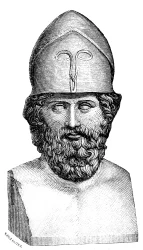
Cleisthenes
- An Aristocrat in a Political Struggle
- Reorganizing the City
- The Return of Political Agency
- A Lasting Political Legacy
Cleisthenes helped reshape Athens at a moment when the city was emerging from decades of tyranny and factional rule. His reforms reorganized civic life around local communities and new political tribes, weakening the old aristocratic networks that had dominated public affairs. Later generations remembered him as a founder of Athenian democracy, though that system developed further long after his time.
An Aristocrat in a Political Struggle
Cleisthenes belonged to the Alcmaeonid family, one of Athens’ leading aristocratic clans. His father was Megacles, and his maternal grandfather was also named Cleisthenes, a powerful ruler of Sicyon. The younger Cleisthenes served as archon in 525/4 BCE, during the tyranny of Hippias, the son of Peisistratus.
After Hippias was overthrown around 510 BCE, Athens entered a struggle over who would control the city. Cleisthenes competed with Isagoras, another aristocratic leader who sought support from Sparta. When Isagoras gained the backing of the Spartan king Cleomenes I, Cleisthenes and other members of his family were forced into exile.
Isagoras’ position soon collapsed. The Athenian people resisted his attempt to rule with Spartan support, and he was driven out. Cleisthenes returned to Athens and proposed a sweeping reorganization of the political system. His reforms, enacted around 508/7 BCE, changed the structure through which citizens participated in public life.
Reorganizing the City
The central change divided the citizens into ten new tribes, replacing the older four tribes associated with ancestry and long-standing kinship ties. Each new tribe brought together demes, or local communities, from different parts of Attica: the urban center, the inland region, and the coast. The design mixed people from places that had previously formed separate power bases, making it harder for a single aristocratic family or region to dominate politics.
Demes became the basic units of civic administration. A citizen’s deme served as a public identifier and helped determine participation in the new political structure. Cleisthenes also expanded the Council, or boulē, from 400 members to 500, with fifty representatives from each tribe. The council prepared business for the assembly and helped manage the routine affairs of the city.
These reforms widened participation among male citizens and gave local communities a more direct place in governance. They did not create universal democracy: women, enslaved people, and resident foreigners remained excluded from political citizenship. Nor did the system stop Athens from being shaped by powerful individuals. Still, the reorganization altered the framework of public life and provided a foundation for the more developed democracy of the fifth century BCE.
The Return of Political Agency
Cleisthenes’ reforms were not a simple gift from an enlightened leader. They emerged from a contest for power and from the need to win popular support against Isagoras and his Spartan allies. Ancient historian Herodotus says Cleisthenes “took the people into partnership,” a phrase that captures both the political strategy and the lasting effect of the reforms.
The new tribes also served military and civic functions, linking citizens across the region. In the decades that followed, Athenians used this system to organize military units, select council members, and conduct public business. Later leaders expanded the assembly’s authority and altered other institutions, so Cleisthenes should be understood as an architect of democracy’s early framework rather than the maker of its final form.
The institution of ostracism is also sometimes attributed to him. Under the procedure, citizens could vote to send a prominent politician into exile for a limited period. The first recorded ostracism came later, and scholars debate exactly when and how the practice was introduced, so its connection to Cleisthenes is not as certain as the tribal and council reforms.
A Lasting Political Legacy
Details of Cleisthenes’ later life are scarce, and ancient sources provide no clear account of his death. His historical importance rests mainly on the institutions associated with his reforms. By reorganizing civic identity around demes and mixing communities within new tribes, he weakened inherited channels of elite influence and made political participation more broadly structured.
The Athenian democracy that developed over the following generations remained restricted by modern standards and was shaped by war, empire, and internal conflict. Yet its civic institutions became a model for later political thought. Cleisthenes stands at the turning point: an aristocrat who responded to a power struggle by creating a new political arrangement, one that gave the Athenian people a more consequential role in their city’s government.