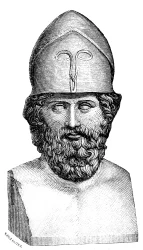
Themistocles
- An Outsider in Athenian Politics
- Building a Fleet
- Walls, Influence, and Rivalries
- An Exile in Persia
- A Legacy of Strategic Vision
Themistocles saw the sea as Athens’ best defense and its greatest opportunity. His advocacy of a powerful fleet helped prepare the city for the Persian invasion of 480 BCE, when he became the leading Greek strategist at the naval battle of Salamis. The victory made his reputation, but the same forceful ambition that had served Athens would eventually contribute to his exile.
An Outsider in Athenian Politics
Themistocles was born around 524 BCE in Athens. His father, Neocles, belonged to the Lycomid family, while his mother was not an Athenian citizen. Ancient accounts therefore present him as a political outsider compared with the city’s traditional aristocrats. The details of his youth are uncertain, and later writers differ in their portrait of his education and temperament. They agree, however, that he was exceptionally quick at reading people and events.
He entered public life as a politician and was archon, Athens’ chief magistrate, in 493/2 BCE. He promoted the development of the port of Piraeus, whose natural harbors offered Athens a base for maritime power. This was part of a larger vision: the city could protect itself and exert influence across the Aegean if it built and maintained a capable navy.
Building a Fleet
A major opportunity came when silver revenues flowed into the Athenian treasury. Rather than distribute the money to citizens, Themistocles persuaded the assembly to invest in warships. Ancient accounts link the resulting fleet to a conflict with Aegina, but it would prove crucial against Persia as well. The policy was controversial, yet it turned Athens toward the sea and created the ships needed for the next great crisis.
In 480 BCE, King Xerxes I invaded Greece with a large Persian force. After the Persians advanced through northern and central Greece, Athens was evacuated and its inhabitants took refuge on nearby islands and ships. At the council of Greek commanders, Themistocles argued for fighting at Salamis, where narrow waters could reduce the advantage of the larger Persian fleet. According to Herodotus, he sent a secret message to Xerxes, encouraging the king to move against the Greeks before they could withdraw. The exact role of this stratagem is debated, but the Persian fleet entered the straits and suffered a decisive defeat.
The Greek fleet was formally led by the Spartan Eurybiades, yet ancient accounts credit Themistocles with pressing the strategy that brought the battle. Salamis did not end the war by itself: Persian forces remained in Greece until their defeat at Plataea the following year. But the naval victory prevented Xerxes from using the sea to support his campaign and became a turning point in the invasion.
Walls, Influence, and Rivalries
After the Persian Wars, Themistocles continued to strengthen Athens. He encouraged the completion of the city’s fortifications and the defenses of Piraeus, arguing that the port and its ships would secure Athens’ future. Thucydides later praised his foresight and ability to understand a situation quickly. Themistocles’ policies helped create the foundations of Athenian naval power, though they also set the city on a course toward greater rivalry with other Greek states.
His influence did not last. Athenian voters eventually ostracized him, using the city’s procedure for sending a prominent citizen into temporary exile. The date is usually placed around 471 or 470 BCE, though the precise chronology is uncertain. Later accounts attribute the fall of this once-celebrated leader to factional politics, his reputation for ambition, and growing concern about his power.
An Exile in Persia
Themistocles first lived away from Athens in Greece, including at Argos. When Spartan leaders accused him of conspiring with Persia, he fled across the Aegean. He reached the Persian court and eventually won the favor of King Artaxerxes I, son of Xerxes. The former defender of Greece was given authority over Magnesia in Asia Minor, as well as other revenues and lands that supported his household.
His service to the Persian king cast a striking shadow over his earlier fame. To the Athenians, his flight and acceptance of Persian favor amounted to treason; to Themistocles, exile had left survival and royal patronage as the available path forward. Ancient sources disagree about the details of his final years. He died in Magnesia around 460 BCE, though the circumstances are uncertain. Stories that he poisoned himself rather than lead a Persian campaign against Greece are dramatic, but cannot be treated as established fact.
A Legacy of Strategic Vision
Themistocles remains one of the most consequential and controversial Athenian leaders of the Persian Wars. He helped turn public wealth into naval strength and saw how geography, timing, and political persuasion could shape a battle. At Salamis, those instincts aligned with a wider Greek resistance and helped stop the Persian advance.
His career also illustrates the risks of success in a fiercely competitive democracy. The city that had depended on his counsel later expelled him, and he ended his life under the protection of the very empire he had fought. Remembered both as a brilliant strategist and as a difficult political rival, Themistocles helped make Athens a naval power while remaining a restless figure whom the city never fully trusted.