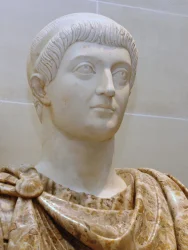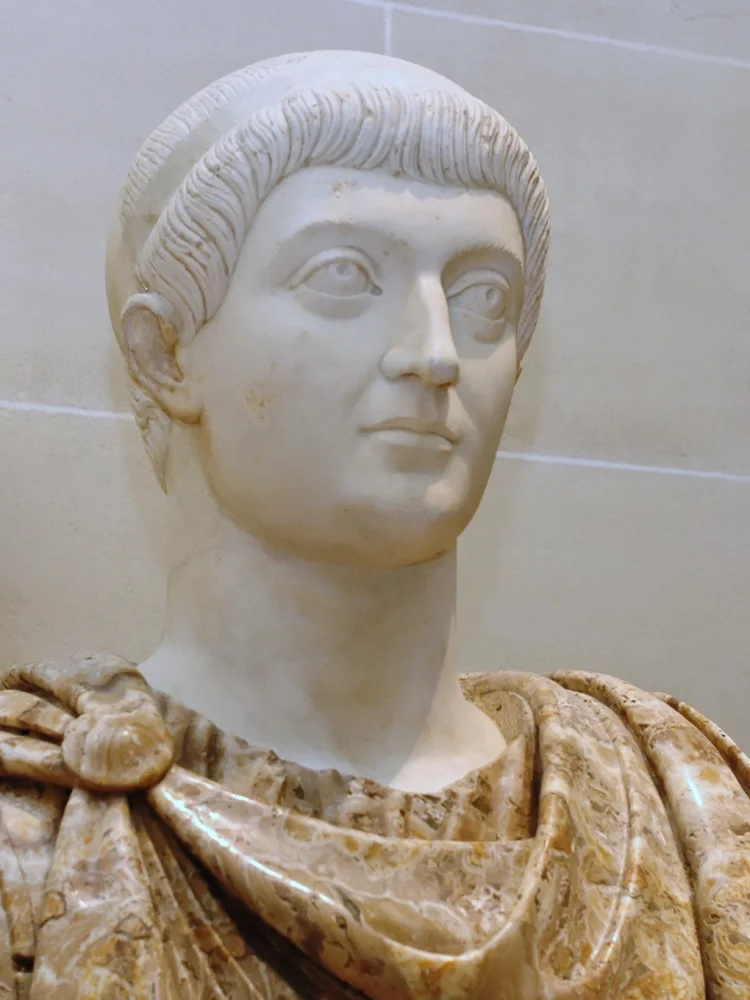
Constans
Constans was the youngest surviving son of Constantine the Great and became a Roman emperor in 337. His reign began with a division of power among Constantine’s sons, but by 340 he ruled the western provinces alone. He maintained the imperial frontier and supported Nicene Christianity, yet his rule ended abruptly in a military coup.
An Empire Divided
Born around 320, Constans was made Caesar, or junior emperor, in 333. After Constantine’s death in 337, Constans and his brothers Constantine II and Constantius II each took the title Augustus and divided the empire among themselves. Constans received Italy, Africa and much of the Balkans, with his exact responsibilities shifting as the brothers negotiated their spheres of influence.
The arrangement broke down in 340, when Constantine II invaded Italy. Constans’s forces defeated him near Aquileia, where the elder brother was killed. Constans then took control of his brother’s western territories, ruling a broad realm that included Gaul, Spain and Britain as well as Italy and Africa.
Rule in the West
Constans faced pressure along the Rhine frontier and campaigned against the Franks. In 343 he crossed to Britain, an unusual visit by an emperor, and took measures to address military threats on the island. He also intervened in Christian disputes. A supporter of the Nicene bishop Athanasius of Alexandria, Constans tried to encourage agreement with his eastern brother Constantius II, whose religious policies differed.
Ancient writers hostile to Constans described him as arrogant and unpopular with his troops. Such accounts must be read with care, since they were written in a political climate shaped by the coup that ended his rule. Even so, the speed with which the revolt spread suggests that he had lost important support among the western military and court.
The Coup of Magnentius
In January 350, soldiers and court officials proclaimed the general Magnentius emperor at Autun in Gaul. Constans fled south but was caught and killed near the Pyrenees, at a place known as Helena. He was about thirty years old. His death launched a struggle between Magnentius and Constantius II for control of the empire; Constantius eventually defeated the usurper and reunited the Roman territories.
Constans’s decade as emperor was shaped by the fragile settlement among Constantine’s heirs. He expanded his authority after his brother’s death and maintained a presence on the western frontiers, but the court and army remained vulnerable to rivalry. His overthrow showed how quickly a ruler’s power could collapse when military loyalty failed.