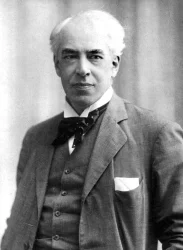
Constantine Stanislavsky
Konstantin Stanislavski was a Russian actor, director, and theatre teacher whose approach to performance reshaped modern acting. Born into a prosperous Moscow family, he became a co-founder of the Moscow Art Theatre and developed a systematic method for helping actors build psychologically credible roles. His ideas spread internationally through his books, students, and the theatre’s tours.
Early life and theatre work
Stanislavski was born Konstantin Sergeyevich Alexeyev in Moscow in 1863. His family supported amateur performance, and he appeared in theatrical productions from a young age. To keep his acting separate from the family business, he adopted the stage name Stanislavski in the 1880s.
He helped establish the Society of Art and Literature in 1888, serving as both performer and director. These early productions gave him room to experiment with rehearsal and staging. Dissatisfied with the theatrical conventions of the time, he sought performances that felt truthful and disciplined, with actors responding to one another rather than relying on declamatory gestures.
In 1897 he met playwright and director Vladimir Nemirovich-Danchenko. Their long planning session led to the founding of the Moscow Art Theatre in 1898. The company pursued ensemble work and realistic staging. Its productions of Anton Chekhov’s plays, including *The Seagull*, *Uncle Vanya*, and *The Cherry Orchard*, became defining achievements of the modern stage.
The system of acting
Stanislavski spent decades exploring how actors could create convincing performances repeatedly, rather than waiting for inspiration. His system asked actors to understand a character’s circumstances, objectives, and relationships, and to build behavior through specific physical actions. Techniques such as “given circumstances,” “objectives,” and “if” helped actors connect imagination and analysis to playable choices.
His approach changed over time. Early emphasis on emotional memory and personal experience gave way to a stronger focus on physical action and the logic of a role. Stanislavski did not present his system as a fixed recipe; he treated it as an evolving body of practice that actors and teachers could test and adapt.
In 1912 he established the First Studio as a laboratory for actor training. After the Russian Revolution, he continued directing and teaching amid political upheaval, and the Moscow Art Theatre toured abroad. His major books, including *My Life in Art* and *An Actor Prepares*, brought his ideas to readers beyond Russia.
Later years and legacy
Stanislavski remained active in theatre until his death in Moscow in 1938. His influence reached well beyond the Moscow Art Theatre. In the United States, teachers and performers adapted aspects of his work into approaches often described as “Method acting,” though those traditions are not identical to Stanislavski’s own system.
His lasting contribution was to treat acting as both an art and a craft that could be studied. He helped shift theatre toward psychological realism, disciplined ensemble work, and sustained actor training. His questions about attention, intention, and truthful behavior continue to shape actors and directors around the world.