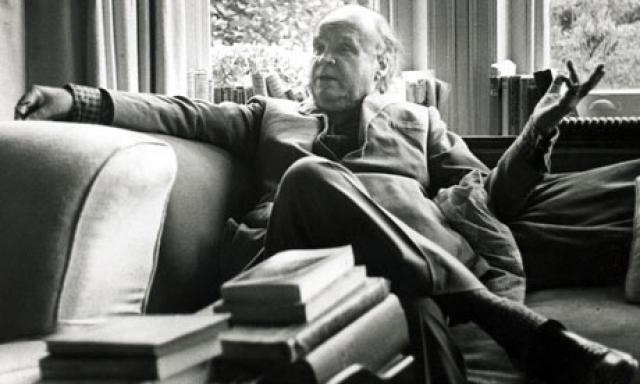
Cyril Connolly
 Great Britain
Cyril Vernon Connolly: An English Intellectual and Writer
Cyril Vernon Connolly, an English intellectual, literary critic, and writer, was born on September 10, 1903, in Coventry, Warwickshire. He was the only child of Matthew William Kemble Connolly, a military man, and Muriel Maud Vernon. Connolly's parents met during his father's service in Ireland, after which Matthew was stationed in South Africa. His father was also a malacologist and a well-known mineral collector who gathered many interesting specimens in Africa. Connolly spent his childhood with his father in South Africa, with his mother's family in Clontarf Castle, and with his paternal grandmother in Bath and other parts of England.
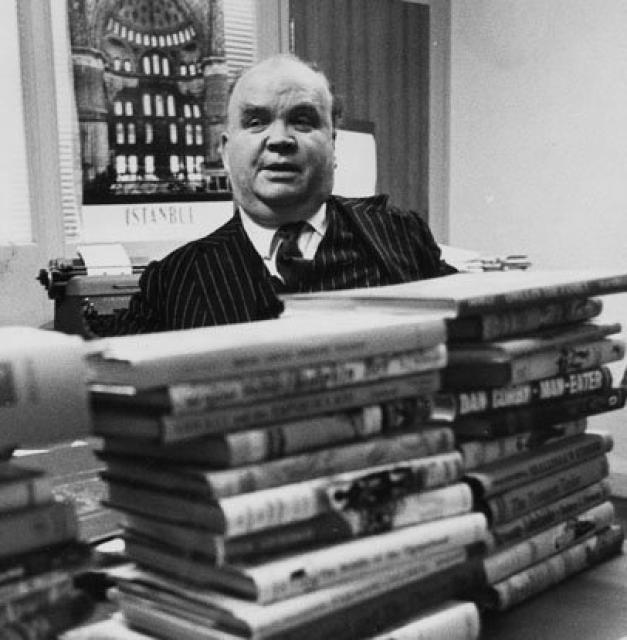
He received his education at St Cyprian's School in Eastbourne, where he became friends with George Orwell and Cecil Beaton. After attending Eton College, Cyril bypassed the difficult adjustment period, earning the favor of his teacher Godfrey Meynell and gaining a reputation as a sharp-witted individual. As a result, he became entangled in romantic intrigues and college politics, which he later recounted in his book "Enemies of Promise."
In the summer of 1921, Connolly's father took him on a holiday to Paris, igniting his passion for travel. The following year, he traveled with his mother to Mürren, where he befriended Anthony Knebworth. By this time, his parents were living separately, with his mother pursuing new relationships and his father delving into alcoholism and a fascination with studying slugs and snails. In 1922, Connolly won the Rosebery History Prize, and he and his school friend embarked on a journey through Spain, Germany, Austria, and Hungary before beginning his studies at Oxford University. His academic career did not flourish as he was constantly drawn to travel. After his final exams at Oxford, Connolly earned a third-class degree in history and struggled to find work, while his friends and relatives attempted to alleviate his enormous debts.
In June 1926, Connolly became the secretary/companion of Logan Pearsall Smith, an essayist and critic, who profoundly influenced Connolly's ideas about the role of a writer, emphasizing the alienation of journalism. Smith paid him eight pounds a week. After a trip to Scotland with his mother, Connolly joined the staff of the New Statesman in August 1927. His first review, about Elizabeth Bowen's hotel, was published in September. Cyril worked on several of his own works, such as the novel "Green Endings" and a book about his travels in Spain, but he went through a moral decline, engaging with prostitutes and spending time in poor areas of London. When he finally settled down and entered into a romance with Racy Fisher, her father, Admiral William Wordsworth Fisher, did everything he could to separate them, leading to their breakup in February 1928. Connolly then visited a Parisian brothel in the guise of a journalist and became acquainted with lesbian poet Mara Andrews. He also traveled to Germany again with Bobby Longden and Raymond Mortimer before spending five weeks in Barcelona before returning to London.
On April 5, 1930, Connolly married Jean Bakewell, a "warm, generous, witty, and accessible" woman, in New York. His independent and enterprising wife helped him financially, allowing him to continue his travels. In November 1931, Connolly made another contribution to the New Statesman and worked as an art critic for the Architectural Review.
Bakewell left him in 1939, later marrying Laurence Vail. She died of a stroke during a trip to Paris at the age of 39. In 1950, Connolly married Barbara Skelton. His third wife, Deirdre Craven, whom he married in 1959, was the granddaughter of James Craig, the first Viscount Craigavon. Connolly had two children from his last marriage. After his death in 1974, Craven married Peter Levi two years later.
In 1940, Cyril founded the magazine Horizon with Peter Watson, a financial backer and art editor. Connolly served as the editor of Horizon until 1950 and also worked as the literary editor of The Observer from 1942 to 1943 until he clashed with David Astor. From 1952 until his death, he was a book reviewer for the Sunday Times alongside Raymond Mortimer.
In 1967, Connolly settled in Eastbourne. He died suddenly in 1974, and two years later, his works and personal library, comprising more than 800 books, became part of the University of Tulsa's collection.
Overall, Connolly always positioned himself as a critic. With his penetrating and often witty interpretations, he exerted significant influence. In his work "The Unquiet Grave," written during World War II, he explained that he never made a concerted effort to live in harmony with reality, resulting in his manic-depressive writing style – vivid, harsh, pessimistic, and tinged with self-pity.
"It is better to write for yourself and have no public than to write for the public and have no self."


