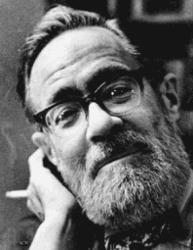
Kenji Nakagami
 Japan
JapanBiography of Kenji Nakagami
Kenji Nakagami was a Japanese writer, literary critic, and poet. He is known as a radical and uncompromising innovator of contemporary Japanese literature and is considered one of the most important Japanese writers of modern times. His works, which some critics classify as magical realism, are characterized by a cosmogonic scale, mythological elements, and a poetic style. His most famous novel is "The Cape of Dried-Up Trees" (1977). He was the recipient of the Akutagawa Prize in 1975 and the Mainichi Prize in 1977. One of his short stories, "Distant Salutations," has been translated into Russian.
Kenji Nakagami was born in Singu, Wakayama Prefecture, as the sixth child in a family of descendants of the Burakumin caste, the outcasts of Japanese society. He spent his childhood and youth in the Kumano region, the citadel of his own mythology. Later, Nakagami described his hometown as "the edge of the world," surrounded by mountains and the ocean, isolated from the outside world. At the age of twelve, Nakagami experienced the suicide of his stepbrother, who hanged himself from a tree. This event, which remained a mystery, had a profound impact on his tragic worldview and greatly influenced his writing.
Growing up in a matriarchal family, Nakagami, being an illegitimate child, was raised together with his stepbrothers and stepsisters by his stepfather, a construction contractor. His relationship with his biological father was minimal. He was the only one in the family who learned to read and write, thanks to the post-war reforms that granted education rights to the Burakumin. After graduating from high school in 1965, Nakagami left Kumano and went to Tokyo to attend preparatory courses before entering Waseda University. However, he seldom attended classes and eventually dropped out. Fascinated by jazz and literature, he began living a bohemian lifestyle. The influence of jazz, especially the late period of John Coltrane's work, had a fundamental impact on Nakagami's writing style.
In 1970, Nakagami married Kasumi Yamaguchi, who is also known as the writer Kivakyo. After getting married, he decided to quit his chaotic lifestyle and became a cargo handler at Haneda Airport in Tokyo, combining strenuous physical work with active writing. He made his debut as a prose writer with the publication of the short story "The First Incident" in the magazine "Bungei" in 1969. Prior to that, some of his poems were occasionally published in the same magazine. He gained attention with the story "The Nineteen-Year-Old's Map" in 1973. In 1975, he received the Akutagawa Prize for his novella "Cape." He was the first writer born after the end of the Pacific War to win this prestigious award. Nakagami's time abroad had a significant influence on him, allowing him to rethink his own identity. At the end of 1977, he spent time in New York, followed by a year in Santa Monica with his family in 1978. After returning from the United States in early 1980, Nakagami moved from Tokyo to the suburbs of Kumano. He spent almost half of 1981 in South Korea, where he discovered Pansori and Korean mask theater. During his stay in Korea, Nakagami began conceptualizing "A Thousand Years of Pleasure," a collection of novellas that would become one of his most significant and distinctive works.
Nakagami's prolific creative activity, which developed in the late 1980s and early 1990s, was tragically cut short when he died from kidney cancer in 1992 at the age of 46, in his hometown of Kumano, the place that inspired his art. Many of his works remained unfinished and were published posthumously in the form in which the author left them.
The formation of Nakagami's style was influenced by Kenzaburo Oe, especially the similarity of the writers' biographies (their peripheral origins and the fact that they both primarily engaged in poetry until their twenties), as well as their attachment to a specific topography. Later, William Faulkner's works, recommended by the prominent literary critic Kojin Karatani, further shaped Nakagami's unique peripheral style. "Cape," essentially Nakagami's first mature work, marked a turning point for the writer. It not only brought him recognition but also set the foundation for his future works, many of which unfold in his hometown in the Kumano Peninsula, where he spent his childhood and youth. The imagery in these works is influenced by the fusion of the unique mythology of Kumano and the everyday life of the Burakumin ghetto. These works are often referred to as "corners," referring to the narrow and winding streets of the ghetto that gave rise to a distinct organization of living space, where "people live like insects, like dogs, surrounded by mountains, rivers, and the sea" ("Cape").
The plot of "Cape" is partly based on autobiographical material. The main character, Akiyuki, reaches the age of 24, the same age at which his stepbrother committed suicide twelve years earlier. This is a pivotal moment for Akiyuki, as many people begin to notice his resemblance to his deceased brother, intensifying his search for resolution to the numerous contradictions that make up his family, which strangely brought together children from different fathers and mothers. This journey, marked by a spontaneous outbreak of violence that occurs in the ghetto, and the disruption of the natural rhythms that Akiyuki, a farmer by occupation, had lived by for a long time, leads him to the internal need to find his real father. He finds his father, but in a specific form: in the final scene, Akiyuki feels his father's blood flowing through him when he loses his virginity in incest with his step-sister, who was born from another woman.
One of the distinguishing features of the work is the non-trivial expression of the protagonist's ambiguous and dualistic desires, which he instinctively tries to resolve. On one hand, he seeks solace in the simplicity of family contradictions, finding stability in his occupation as a farmer. On the other hand, he instinctively tries to resolve these contradictions, as vividly depicted in the ending of the story. "Cape" is the first part of the "Akiyuki Trilogy," followed by the novels "The Cape of Dried-Up Trees" (1977) and "The Edge of Light, the Peak of Time" (1983). The first novel reinterprets the themes introduced in "Cape," while the second novel is an epic work that explores the destruction of the ghetto "corner."
In between these works, Nakagami published the collection of stories "A Thousand Years of Pleasure" (1982), where the world of the Burakumin was given a genuinely mythological dimension, and their history was "rewritten" with the revelation of their divine origin. The themes of "A Thousand Years of Pleasure" were further developed in another cycle called "Kumano" (1984), which became a laboratory for developing a new genre on the border between documentary and artistic prose, as well as mythology.
During his lifetime, Nakagami's work did not receive the recognition commensurate with the scale of his artistic talent. However, after his untimely death, thanks to the efforts of Kojin Karatani and other literary critics, the situation significantly improved. Nakagami received the Akutagawa Prize for "Cape" in 1975, and in 1977, he was awarded the Mainichi Prize and the Japan Ministry of Education Award for "The Cape of Dried-Up Trees."