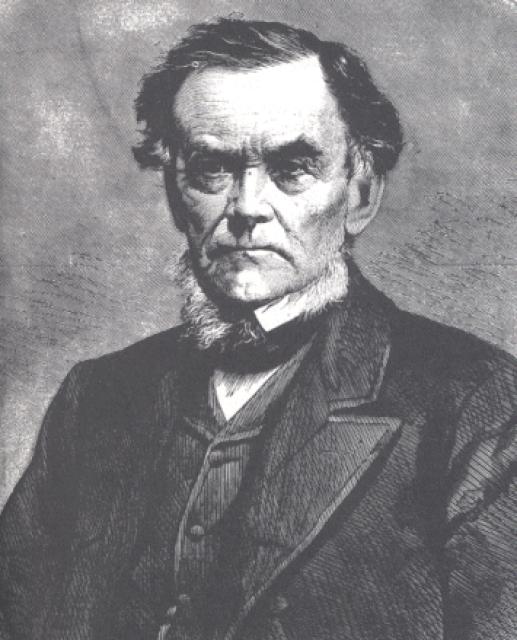
Daniel Drew
 USA
USA- Daniel Drew: The Rise and Fall of a Controversial Financier
- Career in Steamboats and Wall Street
- Origin of 'Watered Stock'
- Schemes and Speculations
- Battle for Erie Railroad
- Financial Ruin and Legacy
Daniel Drew: The Rise and Fall of a Controversial Financier
Early Life and Military ServiceDaniel Drew was born in Carmel, New York, in 1798. Despite his humble origins, he displayed a keen business acumen from a young age. He enlisted in the army at the age of 15, but arrived too late to participate in the War of 1812. After his discharge, he turned his attention to livestock, becoming a successful breeder.
Career in Steamboats and Wall Street
In 1834, Drew ventured into the burgeoning steamboat industry, where he became a formidable competitor to Cornelius Vanderbilt. While he failed to eclipse the transportation tycoon, he established several successful ventures in and around New York City. In 1844, he founded the brokerage firm 'Drew, Robinson & Company', which dissolved a decade later after the deaths of his partners. However, Drew continued his career as an independent broker.
Origin of 'Watered Stock'
Drew is credited with coining the term 'watered stock', referring to the practice of artificially inflating the value of company shares. The term is believed to have originated from his livestock experience, where animals could be sold at a higher price by feeding them extra water to increase their weight.
Schemes and Speculations
Drew joined the board of directors of the Erie Railroad in 1857, where he exploited his position to manipulate stock prices. In 1864, he engaged in a battle with Vanderbilt over the New York and Harlem Railroad shares, a conflict that resulted in Drew losing $500,000.
Battle for Erie Railroad
From 1866 to 1868, Drew, James Fisk, and Jay Gould orchestrated a complex scheme to gain control of the Erie Railroad. They succeeded in outmaneuvering Vanderbilt, who lost a significant amount of money and control of the company. However, Drew's victory was short-lived. In 1870, Fisk and Gould betrayed him, costing Drew $1.5 million.
Financial Ruin and Legacy
The Panic of 1873 devastated Drew's financial empire, and he declared bankruptcy in 1876 with debts exceeding $1 million. He remained bankrupt until his death in 1879, never recovering his former wealth. Despite his controversial business practices, Drew was a devout Methodist and made significant contributions to religious institutions, including the founding of Drew Theological Seminary and Drew Seminary for Young Ladies.