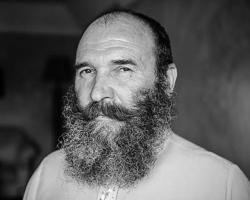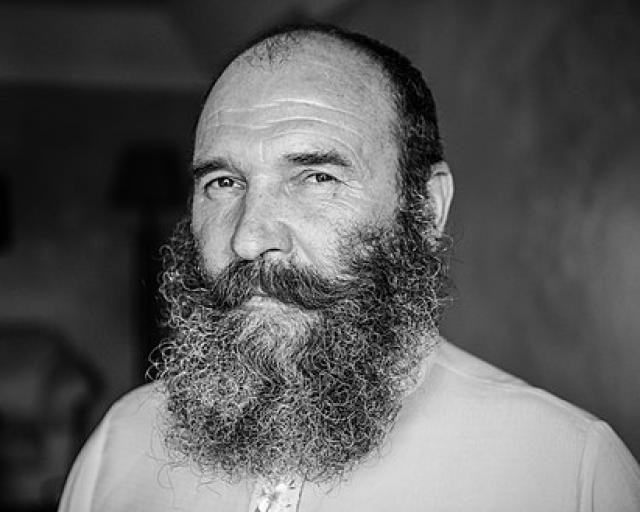
Danila Zaitsev
 Argentina
Danila Zaitsev’s life spans a route that reads like a family epic: from a Russian Old Believer community in western China to Argentina and, over the years, across several countries in the Americas. He turned that experience into an unusually direct literary record, writing about faith, migration and everyday life in a Russian dialect preserved far from Russia.
Childhood Between Worlds
Born in 1959 in China’s Xinjiang region, Zaitsev came from a family belonging to the Chapel Accord, a branch of the priestless Old Believers. His ancestors were Russian religious dissenters whose communities had carried their traditions through successive migrations. When he was about two years old, his family was among the first Old Believer households from Xinjiang to relocate to Argentina in 1961, traveling with the help of the Red Cross.
Zaitsev grew up in Argentina, but family ties and work took him through Uruguay, Brazil, Bolivia, Chile, the United States and Russia. His formal schooling ended after four years in an Argentine school. That limited classroom education did not keep him from becoming a compelling chronicler of his community’s memory and speech.
A Book in His Own Voice
Zaitsev’s major work, The Tale and Life of Danila Terentyevich Zaitsev, grew from his own recollections and from stories about the Old Believers’ journey from Russia to China and then to Latin America. It captures both the large arc of migration and the texture of daily life: work, family, religious practice, travel and the search for a place where a community can live according to its beliefs.
The book’s language is part of its force. Zaitsev wrote in the Russian dialect spoken by Old Believers in South America, using phonetic spelling to represent speech as he heard and pronounced it. Editors prepared the published text for readers, but the distinctive voice remained central. The result drew attention from literary critics and scholars as a rare record of a living diaspora culture.
Recognition and Legacy
The book received Russia’s NOS literary prize in 2015 and also reached the shortlist for the Yasnaya Polyana Award, with longlist recognition from other major Russian literary prizes. Its reception brought an author from a small, little-known religious community into public literary discussion.
Zaitsev was also the central figure in the documentary The Rescue (2016), which followed his travels and encounters. His work stands at the meeting point of personal testimony, family history and cultural preservation. By setting down the memories and speech of his community in his own words, he made a story of migration legible to readers far beyond its original circle.