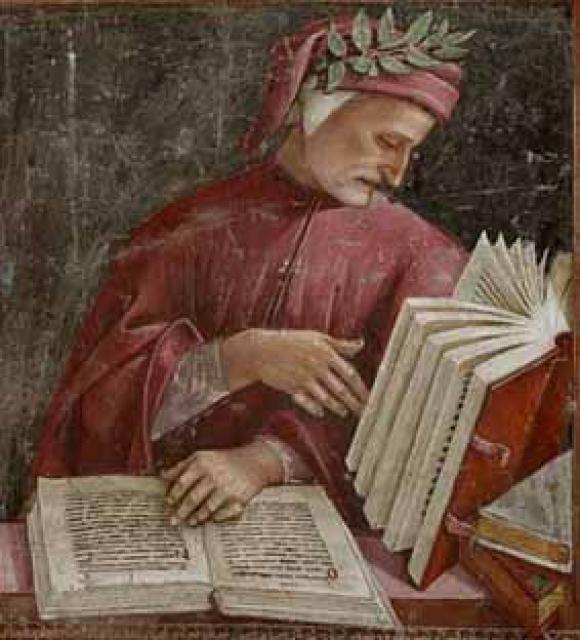
Dante Alighieri
 Italy
ItalyBiography of Dante Alighieri
Dante Alighieri was an Italian poet, literary critic, theologian, and political activist. He is renowned in the history of world literature as the author of the monumental epic work, "La divina commedia" ("The Divine Comedy"), which reflects the Christian morality's perspective on the transient and fleeting human life.
Early Life and Education
Dante Alighieri was born between May 21 and June 20, 1265, in Florence, Italy, and remained devoted to his hometown throughout his life. Little is known about Dante's family, as his father, mother, and siblings are not mentioned in "The Divine Comedy." It is believed that his mother, named Bella, passed away at an early age. After her death, Dante's father remarried Lapa di Chiarissimo Cialuffi, with whom he had a son, Francesco, and a daughter, Gaetana. Dante's father passed away around 1283, leaving the children a modest but comfortable estate in Florence and a country house. During this period, Dante married Gemma Donati.
Literary and Political Activities
Dante's life became intertwined with the prolonged conflict between the Emperor and the Pope, which significantly influenced Florence at the time. Brunetto Latini, a former exile and Dante's friend and mentor, played a significant role in Florence. Latini possessed encyclopedic knowledge and frequently quoted Cicero, Seneca, Aristotle, and, of course, the Bible. Latini had the most profound impact on Dante's early development, nurturing his sense of the beautiful.
Dante was a remarkably self-assured individual. At the age of 18, he claimed to have mastered the art of writing poetry on his own. His relationship with Guido Cavalcanti, another talented friend, was quite complex. Despite their friendship, Dante was forced to participate in the exile of Guido from Florence. Guido later contracted malaria and passed away in 1300. Dante wrote numerous poems in honor of his extraordinary talent. His work "Vita Nuova" ("New Life") contains numerous excerpts dedicated to Cavalcanti. In this work, Dante also expressed his first youthful love for Beatrice. Biographers identify Dante's beloved with Beatrice Portinari, who died at the age of 25 in Florence in 1290. Dante and Beatrice became a symbol of love, like Petrarch and Laura, Tristan and Isolde, and Romeo and Juliet.
Philosophical Reflections and Literary Achievements
The death of his beloved Beatrice initiated Dante's philosophical reflections on life and death. He began reading Cicero extensively, and Philosophy became his new muse, occupying all his thoughts. Dante started attending a religious school in Florence. In 1295, Dante joined a guild, whose membership paved the way for a political career. This was a time of heightened conflict between the Emperor and the Pope, and the city of Florence became divided into two opposing factions: the "Blacks," led by Corso Donati, and the "Whites," to which Dante belonged. The "Whites" emerged victorious and expelled their opponents from the city.
In 1300, Dante participated in an honorary embassy to San Gimignano. In the same year, he was elected to the city council, where his poetic oratory skills shone. Dante increasingly became an opponent of the Pope, participating in anti-papal coalitions. By that time, the "Blacks" had intensified their activities, invaded the city, and unleashed a pogrom against their political adversaries. Dante was summoned to the city council several times but refused to go. Consequently, on March 10, 1302, Dante and 14 other "Whites" were sentenced to death in absentia. To save his life, he had to leave his native city.
Exile and Literary Pursuits
Initially, Dante actively participated in the preparation of a military revenge but to no avail. Disillusioned with politics, Dante returned to literature and continued writing "Convivio." During his years of exile, he embarked on his life's work, "The Divine Comedy."
In this magnificent masterpiece, Dante aimed to help people confront the fear of death realistically. This task was highly relevant at the time, as medieval individuals were tormented by the terror of hellish torments, torn between the commandments of ancient and Christian gods. Dante did not advise forgetting impending death like Epicurus, nor did he claim, like Enlightenment philosophers, that hell was a fabrication of the clergy. He believed in the actual existence of hell and that courage, honor, and love could help individuals escape unharmed. "The Divine Comedy" begins with the author's attempt to express his grief through verses, seeking to preserve the pure image of his beloved Beatrice. However, he unexpectedly realizes that she, blessed and innocent, is immune to death and can save him from perdition. With the help of Vergil, Beatrice guides Dante and the readers through the horrors of hell. At the gates of hell, the inscription reads, "Abandon all hope," but Vergil advises Dante to abandon all fear, for only with open eyes can one comprehend the roots of evil. According to Dante, the soul of a person can descend into hell both during life and after death because hell is not a place but a state in which one finds themselves when under the dominion of sin. Even if it is the sin of hatred, both the victim and the executioner will be cast into hell together, and as long as the victim continues to hate their torturer, they will be unable to escape hell.
Later Years and Death
In November 1308, Henry was crowned the King of Germany, and in July 1309, the new Pope Clement V declared him the King of Italy and invited him to Rome, where Henry was crowned as the Emperor of the Holy Roman Empire. Dante, who was an ally of Henry, once again immersed himself in politics. His literary experience proved invaluable as he wrote numerous pamphlets and delivered many speeches.
Dante Alighieri passed away on the night of September 13-14, 1321, in Ravenna.


