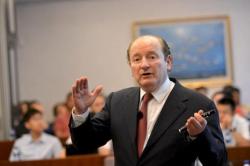
David Cass
 USA
USABiography of David Cass
David Cass, an American economics professor, is primarily known for his contributions to the general equilibrium theory. His most famous work, based on the Ramsey growth model, is known as the Ramsey-Cass-Koopmans model.
Early Life and Education
David Cass was born on January 19, 1937, in Honolulu, Hawaii. He earned his bachelor's degree in economics from the University of Oregon in 1958. Initially, Cass intended to study law at Harvard Law School to pursue a career as a lawyer, maintaining family traditions. However, after a year of disliking the program, he dropped out and served in the military from 1959 to 1960.
After completing his military service, Cass began his studies at Stanford University, where he met Karl Shell. They started collaborating after both obtaining their Ph.D. degree. Hirofumi Uzawa, who introduced Cass to Tjalling Koopmans, served as his doctoral advisor. Koopmans was a professor at Yale University at the time.
Academic Career
In 1965, Cass presented his dissertation on economic optimal growth, a part of which was later published as "Optimum Growth in an Aggregative Model of Capital Accumulation." From 1965 to 1970, he served as an associate professor at the Yale University Economics Department and as a research associate at the Cowles Commission for Research in Economics in New Haven. At Yale, he collaborated with Menahem Yaari and Joseph Stiglitz, primarily focusing on overlapping generations models.
In 1970, Cass moved to Pittsburgh, joining Carnegie-Mellon University as an economics professor, where he worked alongside Karl Shell until 1974. One of his graduate students at the time was Finn E. Kydland, who later received a Nobel Prize in Economics. In 1974, David Cass relocated to the University of Pennsylvania, where he remained a professor of economics until his death.
Contributions and Recognition
Cass made significant contributions to pure economic theory, particularly in the field of general equilibrium theory. He also contributed to the theory of optimal growth, solar spot theory, and imperfect competition theory. In his most notable work, "Optimum Growth in an Aggregative Model of Capital Accumulation," he establishes the necessary and sufficient conditions for efficiency improvement in the neoclassical growth model, initially introduced by Frank Ramsey. However, the main difference from Ramsey's standard growth model is that the financing structure of government spending does not affect aggregate household spending. This modified version is named after Ramsey, Cass, and Koopmans.
David openly advocated for academic and personal freedoms. In 1994, he played a significant role in establishing the Beth Hayes Prize at the University of Pennsylvania. Originally, the prize was awarded every two years to a woman who made the most significant contributions to economics during that time. Later, with Cass's approval, the award was extended to male students as well. Following Cass's death, the prize was renamed the Beth Hayes/David Cass Prize for Achievements in Economics.
Cass received various honors throughout his career. He was a Guggenheim Fellow in 1970, elected as a member of the Econometric Society in 1972, and received an honorary doctorate from the University of Geneva in 1974. In 1999, he became an honorary fellow of the American Economic Association, and starting from 2003, he was a member of the American Academy of Arts and Sciences.
David Cass passed away on April 15, 2008, in Philadelphia after a prolonged illness. He was divorced and left behind two children.