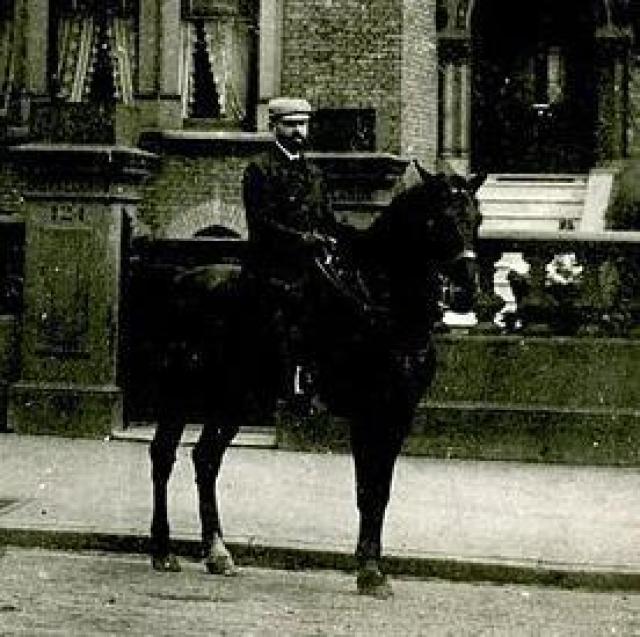
David Gestetner
 Great Britain
- David Gestetner: Pioneer of Stencil Duplication
- Gestetner Cyclograph Company
- Revolutionizing Copying
- Global Expansion and Improvements
- Social and Political Impact
- Corporate Growth and Legacy
David Gestetner: Pioneer of Stencil Duplication
Early Life and InventionDavid Gestetner was born in Csorna, Hungary, on March 20, 1854. While working as a clerk on the Vienna stock exchange, he became frustrated with the laborious task of copying market statistics. Inspired by an accidental ink spill onto a stack of papers, Gestetner developed a novel method of reproducing documents using stencils.
Gestetner Cyclograph Company
In Chicago, Gestetner began manufacturing kites made from Chinese paper. His idea for a copying machine was further developed after he accidentally toppled an ink bottle over a stack of paper, realizing that each sheet had a perfectly shaped inkblot. Gestetner's stencil printing technique involved a thin sheet of fibrous paper coated in wax. A stylus was used to etch images or text into the wax, allowing ink to be forced through the grooves onto blank sheets of paper.
Revolutionizing Copying
Before Gestetner's invention, making multiple copies of contracts, agreements, or letters required manual duplication and proofreading, which was time-consuming and prone to errors. Stencil duplicating enabled the creation of a single master copy that could be reproduced with precision. Gestetner eventually moved to London and founded the Gestetner Cyclograph Company in 1881 to manufacture stencils, styluses, inking rollers, and other equipment. He patented his primary invention and also developed other useful devices, such as manicure scissors and a ballpoint pen.
Global Expansion and Improvements
Gestetner's stencil duplicator gained immediate worldwide popularity, and he soon established a network of Gestetner Cyclograph Company branches to sell and service his products. The copier was refined over the years, with Gestetner employing a pair of synchronized rotating drums, one holding the master and the other the copy. Each complete rotation produced a finished copy. The invention of the typewriter led to the introduction of a typewriter stencil, enabling duplication in the style of newspapers and books rather than handwritten material.
Social and Political Impact
Stencil duplicators empowered individuals to create and distribute uncensored print copies of their ideas or writings. This allowed for the free display of notices at factories, churches, government offices, parks, and other public spaces without having to rely on the often expensive and potentially censorious services of printing presses.
Corporate Growth and Legacy
The Gestetner Cyclograph Company expanded rapidly in the early and mid-20th century. Management passed to David's son, Sigmund, who later bequeathed the business to his own sons, David and Jonathan. Gestetner also acquired several other companies, including Nashua (later Nashuatec), Rex Rotary, Hanimex, and Savin, eventually creating the holding company NRG. David Gestetner passed away in London on March 8, 1939. The Gestetner Company was acquired by the Japanese company Ricoh in 1996.


