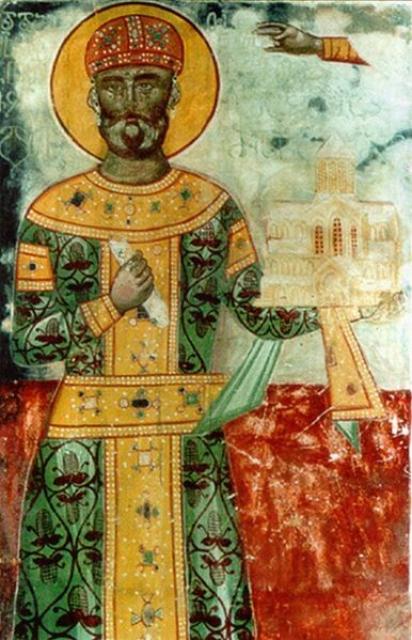
David IV Agmashenebely
 Georgia
- David IV: The Unifier and Reformer of Georgia
- David's Rise to Power
- Military Reforms
- Church Reforms
- Military Strength
- Expansion and Unification
- The Battle of Didgori
- The Liberation of Tbilisi
- Expansion and Legacy
David IV: The Unifier and Reformer of Georgia
The State of Georgia in 1089Upon his accession in 1089, David IV inherited a Georgia in a dire state. The kingdom's authority had dwindled to a mere hold over Western Georgia, with Kakheti-Hereti seeking independence, Tbilisi under Muslim rule, and vast territories ravaged by the Seljuk Turks.
David's Rise to Power
Recognizing the need to restore stability, David IV moved swiftly to assert his authority. He banished Liparit V, a defiant noble, and subdued Dzagani, the ruler of the Zedazeni fortress. By demonstrating his resolve, David ended the era of feudal insubordination that had plagued Georgia.
Military Reforms
David IV organized loyalist military units to combat the Turks, restoring discipline and order within the Georgian army. He seized the opportunity of the Seljuks' preoccupation with the crusades to cease paying tribute in 1099.
Church Reforms
The Seljuk invasions had severely weakened the Georgian state apparatus, including its ecclesiastical institutions. David IV convened the Ruisi-Urbnisi Church Council in 1104 to purge the clergy of corrupt and disloyal elements. He established the position of Mtskignobartukhutsesi-Chkondideli, uniting ecclesiastical and secular powers under a single authority.
Military Strength
To effectively resist the Seljuks, David IV implemented military reforms. He formed a personal royal guard, the Monaspa, and divided the army into three branches: the Monaspa, city and fortress garrisons, and a main force. In 1118, he relocated 40,000 Polovtsian families from the North Caucasus, strengthening the military potential of Georgia.
Expansion and Unification
In 1104, David IV annexed Kakheti-Hereti to his domain. His decisive victory over the Ghazni Emir in 1104 solidified his position within Georgia. Between 1110 and 1118, he liberated several cities and fortresses from Seljuk control, including Samshvilde, Rustavi, Gishi, and Lore.
The Battle of Didgori
Sultan Mahmud's massive army of 300,000 soldiers posed a formidable threat to Georgia. Despite being outnumbered, David IV's 60,000 troops, including Polovtsians, Alans, and crusaders, faced the Seljuks at Didgori on August 12, 1121. Through clever tactics, David's forces lured the Seljuks into a narrow gorge, ensuring their advantage. A daring assault by 200 Georgian warriors sowed chaos in the enemy ranks, leading to a decisive Georgian victory.
The Liberation of Tbilisi
Following the triumph at Didgori, David IV liberated Tbilisi in 1122 and restored peace and order to the city. He respected the religious freedoms of all residents, imposing a modest tax on Muslims.
Expansion and Legacy
David IV's reign saw the expansion of Georgian influence to Shirvan and northern Armenia. He died on January 24, 1125, leaving behind a unified Georgia stretching from the Black Sea to the Caspian. The Georgian Church canonized David IV as a saint, with his feast day celebrated on January 26 (February 8).