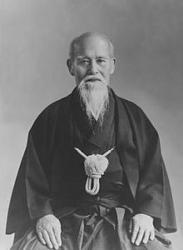
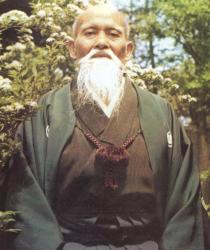
Deguchi
 China
China- On His Father's Grave: A Spiritual Awakening
- A Divine Revelation: Deguchi's "Way to Heaven"
- Ueshiba's Encounter with Deguchi
- Fleeing to Mongolia: A Test of Faith
- Spiritual Intuition and the Birth of Aikido
- Legacy and Impact
On His Father's Grave: A Spiritual Awakening
In 1919, Morihei Ueshiba left Shirataki to visit his ailing father in Tanabé. On his journey, he encountered numerous accounts of a renowned monk and healer residing in Ayabé, Reverend Deguchi (formerly known as Ueda Kitasaburo). Deguchi was the spiritual leader of Ōmoto-kyō, the Sect of the Great Origin.
A Divine Revelation: Deguchi's "Way to Heaven"
In 1898, Deguchi experienced a divine revelation. He heard a "heavenly voice" instructing him to "know the most pure and noble way—the way that leads to Heaven. You must purify your body and soul, so that you may awaken the people. You must become a Servant of God. Spread the Light into the world. Become the Salt of salvation and purification."
This message became the cornerstone of Ōmoto-kyō's teachings. Deguchi emphasized the importance of love, selfless service, and inner purification. He believed that by following this path, individuals could attain spiritual enlightenment and contribute to the betterment of society.
Ueshiba's Encounter with Deguchi
Ueshiba visited Deguchi in late September 1919 and remained in Ayabé until December 28. During this time, he became deeply influenced by Deguchi's teachings. Ueshiba received a traditional martial arts training in Daitō-ryū aikijutsu from Deguchi's students and became an official instructor at the Ōmoto-kyō dojo.
Fleeing to Mongolia: A Test of Faith
In 1924, Deguchi and several followers, including Ueshiba, traveled to Inner Mongolia in defiance of a government ban. Their mission was to establish a "Kingdom of God" and distribute aid to the local population. However, their actions were met with opposition from Chinese authorities. Deguchi and his companions were imprisoned and sentenced to death. Only with the intervention of the Japanese consulate were they able to return home safely in 1925.
Spiritual Intuition and the Birth of Aikido
This near-death experience transformed Ueshiba's perspective on martial arts. He realized that true strength lay not in physical force but in inner harmony and spiritual awareness. In 1926, after an intense period of training, Ueshiba experienced a vision that became the foundation of Aikido. He described it as a moment when he felt enveloped by a golden energy that connected him to the "Heart of the Universe."
This experience led Ueshiba to break away from Daitō-ryū aikijutsu and create his own martial art, which he initially called "Aiki-bu-jutsu." In 1942, he officially adopted the name "Aikido," meaning "the way to harmonize energy."
Legacy and Impact
Morihei Ueshiba's spiritual journey had a profound impact on the development of Aikido. He combined traditional martial arts techniques with philosophical principles drawn from Shingon Buddhism, Taoism, and Ōmoto-kyō. As a result, Aikido became a unique blend of self-defense, spiritual practice, and personal development.
Ueshiba's teachings continue to inspire martial artists and spiritual seekers around the world. His emphasis on inner harmony, respect for others, and the pursuit of peace have made Aikido a valuable tool for personal growth and conflict resolution. Today, Aikido is practiced in over 140 countries, with millions of practitioners globally.