Demetriy I
 Syria
- A prince in the age of the Successors
- The “Besieger of Cities”
- King of Macedonia and final campaign
- Legacy
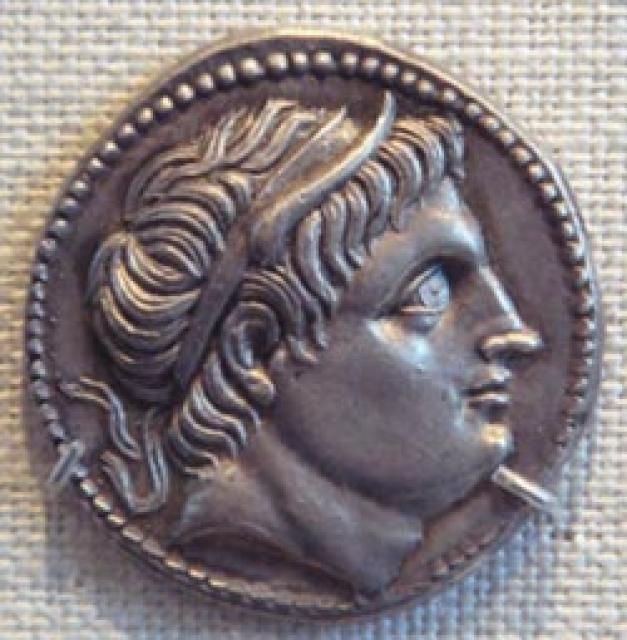
Demetrius I Poliorcetes was a Macedonian commander and king who fought to shape the kingdoms left behind after the death of Alexander the Great. Renowned for his bold campaigns and remarkable siege machinery, he won and lost territory across Greece and Asia Minor, ruled Macedonia for several years, and became known by a title that means “Besieger of Cities.”
A prince in the age of the Successors
Demetrius was born around 336 BCE, the son of Antigonus I Monophthalmus, one of Alexander’s leading generals, and Stratonice. After Alexander died in 323 BCE without a clear successor, his commanders fought for control of the empire. Demetrius grew up in this unsettled world and became one of his father’s principal military leaders.
In 307 BCE, he led an expedition to Greece and drove the Macedonian-backed regime from Athens, presenting the Antigonid campaign as a restoration of Greek freedom. The Athenians welcomed him with extraordinary honors. A year later, after a victory over the fleet of Ptolemy I at Salamis in Cyprus, Antigonus declared himself king and also bestowed the royal title on Demetrius. Their claim to rule the former empire was ambitious, and other Successor rulers soon adopted the title of king as well.
The “Besieger of Cities”
Demetrius gained his famous surname during the siege of Rhodes in 305–304 BCE. Determined to force the island city to submit, he brought an immense force and an array of engines to its walls. The best known was the helepolis, or “City-Taker,” a towering mobile siege machine fitted with artillery. The Rhodians resisted, and the siege ended through negotiation rather than conquest. Demetrius nevertheless became celebrated for his ingenuity and relentless approach to siege warfare.
His fortunes shifted dramatically at the Battle of Ipsus in 301 BCE. Antigonus was killed, and their forces were defeated by a coalition led by Seleucus and Lysimachus. Demetrius escaped with part of his fleet and continued to hold territories and allies around the Aegean, but the defeat destroyed the larger Antigonid bid to control Alexander’s empire. His title “king of Asia” belongs to the period of Antigonid ascendancy between 306 and 301, when his authority was contested and ultimately broken at Ipsus.
King of Macedonia and final campaign
Demetrius later recovered influence in Greece. He regained Athens in 295 BCE and took the Macedonian throne in 294. He ruled Macedonia until 288, when Lysimachus and Pyrrhus attacked from opposite directions and forced him out. Still determined to recover a kingdom, Demetrius campaigned in Asia Minor, but his position weakened. He eventually surrendered to Seleucus in 285 BCE and was held in captivity.
Demetrius died in 283 BCE, after about two years as a prisoner. His son Antigonus II Gonatas later established the Antigonid dynasty on the Macedonian throne, turning his father’s turbulent ambitions into a more durable line of rule.
Legacy
Demetrius’s career captures the volatility of the Successor age: dazzling victories and grand political claims repeatedly gave way to defeat and exile. His reputation rested not only on kingship but also on the mechanics of warfare. The huge machines built for his sieges made a lasting impression on ancient writers, while his nickname survived as a reminder of the engineering and spectacle he brought to the battlefield.