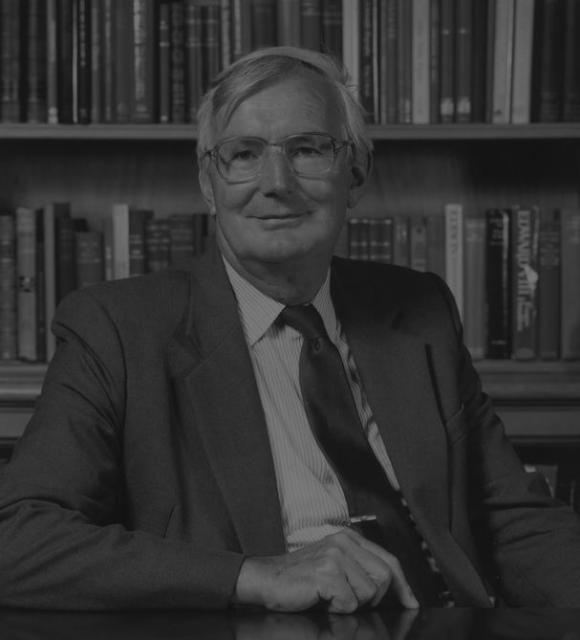
Dennis Greenland
 Great Britain
- Early Life and Influences
- Scientific Career
- Other Scientific Activities
- Family
- Honors and Awards
- 1974 Fellow of the Institute of Biology
Early Life and Influences
Born on January 13, 1937, in the naval city of Portsmouth, England, Dennis Greenland was the son of James John Greenland and Lily Florence Greenland. Initially considering a career in the Royal Navy, in which three generations before him had served, he sat the entrance examination for the Royal Naval College Dartmouth but was unable to take up the place due to poor eyesight. He subsequently won a scholarship to attend Portsmouth Grammar School (1941-1948), which was temporarily evacuated to Bournemouth until 1944 due to bombing.
At school, Greenland was particularly influenced by his Headmaster, Mr Lindsay, and his two chemistry teachers, Mr Tweed and MrStrawson. This led him to obtain a State Scholarship to study chemistry at Christ Church College, Oxford. He graduated in 1952 with First Class Honours; however, before his fourth and final year, which was devoted to a research project, he asked his tutor, A. S. Russell, if he could undertake an element of research that was chemistry-based but would allow him to work both outside and inside the laboratory. As a result, Greenland took a course in soil science taught by Dr E.Walter Russell in the soil science laboratory. For his doctorate, he investigated the interactions of organic materials with clay mineral surfaces—a topic that would occupy him for the rest of his life.
Towards the end of his time at Oxford, Greenland was invited to join the university expedition to the West Nile District of Uganda, where he spent four months with the team led by anthropologist Dr J. F. M. Middleton. Together, they demonstrated that tribal migrations were largely driven by loss of soil fertility brought about by demographic pressure.
Scientific Career
Greenland's interest in clay minerals and the experience he had gained of the influence of organic matter on tropical soils in West Africa continued to shape his research direction when he arrived in South Australia to take up a lectureship in the University of Adelaide in 1959. Many South Australian soils are highly susceptible to loss of aggregate stability upon cultivation; they slake and crust on wetting, leading to severe erosion, loss of topsoil, and the formation of a surface seal that prevents emergence of seedlings. Active collaboration on this problem was underway in the early 1960s between soil scientists in the University of Adelaide at the Waite Institute and in the Commonwealth Scientific and Industrial Research Organization (CSIRO).
At the Waite Institute, Dennis Greenland used the experience he had gained in Ghana to study aspects of the nitrogen and carbon cycles in South Australian soils. Using a kinetic approach, he calculated the accumulation and depletion constants for soil organic matter in a clay loam soil at Waite and hence the durations of the cultivation and pasture phases that would maintain a stable rotation. Greenland also worked with Koji Wada and Ann Hamblyn to characterize the amorphous clay minerals that form from volcanic basaltic lavas and that have a large, pH-dependent variable charge. Such clay minerals consist of morphologically continuous gels grading into poorly crystalline fragments that act as high molecular weight polymers, binding soil particles together. Methods were developed for extracting and analyzing these elusive and easily altered clay minerals using samples from geologically young Australian ando soils of volcanic sites in southeastern Australia.
Dennis Greenland embarked on a series of experiments to investigate the mechanisms by which sugars, polyvinyl alcohols, amino acids and peptides, alkyl ammonium ions, and polysaccharides are adsorbed by clays. This work showed that several mechanisms of interparticle bonding can be involved, including cation exchange, van der Waals forces, physical adsorption, and ligand exchange. Among the more important findings was the demonstration of the large increase in entropy that arises from the displacement of water molecules from the clay surface upon the adsorption of large molecules. In parallel with these studies, using pure chemicals and clay minerals, Greenland turned his attention to how such processes could affect soil structure formation and stability in different soil types. Through selective oxidation, he showed that polysaccharides are involved in binding particles into soil aggregates. This led to the development of extraction methods that facilitated the removal and characterization of soil polysaccharide fractions and hence to an increased understanding of their origins, amounts, and characteristics. Greenland also concluded that, although plant litter and roots are the main sources of carbohydrates in soil, the composition of soil carbohydrates suggests a microbial origin.
Other Scientific Activities
Dennis Greenland was President of the British Society of Soil Science in 1980, and his international and scientific experience was frequently drawn upon by others. One of his more notable contributions was to focus attention on the need to develop new systems of soil and water management to capitalize on the advances in crop breeding provided by several Institutes under the umbrella of the Consultative Group on International Agricultural Research.
By the late 1970s, soil scientists increasingly recognized the need for increased research effort to address environmental and natural resource management issues associated with a global expansion of food production. Considerable advances had been made in crop improvement programs, but pollution and land degradation required increasing attention. Dennis Greenland's intellectual response to these issues can be seen in his plenary lecture given at the closing session of the 11th Congress of the International Society of Soil Science in Edmonton, Canada; his paper stressed the need to maintain a favorable balance in the food-population equation, which he argued could only be achieved on the basis of a sound understanding of fundamental soil processes.
Family
Dennis Greenland was a hard-working and highly supportive individual who patiently mentored many of his students and colleagues. During his school and university years, he played soccer, captaining the Christ Church Cardinals college team. Sport was always an important part of his life, from cricket in Ghana and Australia to golf in the Philippines, UK, and New Zealand.
While at Oxford, he met Mary Johnston, a New Zealander who was working as an orthopedic nurse at Wingfield Morris Hospital. They were introduced by a fellow New Zealander, Lloyd Evans. They were married in St Jude's Church, Southsea, on 27th August 1955. Greenland was by this time one year into his contract in Ghana, and so the newlyweds traveled out there. Mary was a great support to Dennis throughout his life, and there are many memories of her hospitality and kind heart. They had three children, Judith (1956), Rohan (1961), and Jennifer (1962).Judith had a career in human resources management; Rohan was Director of Public Relations for the Australian Medical Association; and Jenny studied medicine at Barts in London and went on to a career in general practice in the NHS.
Honors and Awards
1952 Bachelor of Arts, First Class Honors, Oxford University1955 Master of Arts, Oxford University
1956 Doctor of Philosophy, Oxford University
1969 United States Department of Agriculture Special Overseas Fellowship for work at the University of Minnesota
1974 Fellow of the Institute of Biology
1972 Honorary Doctorate, University of Gent, Belgium1987 Member of the World Academy of Arts and Sciences, Switzerland
1988 Visiting Professor, University of Reading, UK
1993 Honorary Fellow, American Society of Agronomy
1993 Honorary Fellow, Soil Science Society of America
1994 Fellow of the Royal Society
2003 Honorary Doctor of Science, Ohio State University, Columbus, USA
Recognition
Dennis Greenland was an outstanding soil scientist who combined the precision of an analytical chemist with the practical application of an agricultural scientist. His early research used X-ray diffraction and other novel analytical methods to determine the surface properties of clay minerals and their interaction with organic components of soils. This, in turn, led to research aimed at understanding the forces that lead to aggregate and structural stability (and instability) in soils of the UK, Australia, Nigeria, and the tropics in general. At the same time, Dennis addressed practical problems faced by farmers in the tropics maintaining the fertility of their soils and ensuring long-term crop production; his early work (with Peter Nye) on shifting cultivation is considered a classic in the soil science literature.




