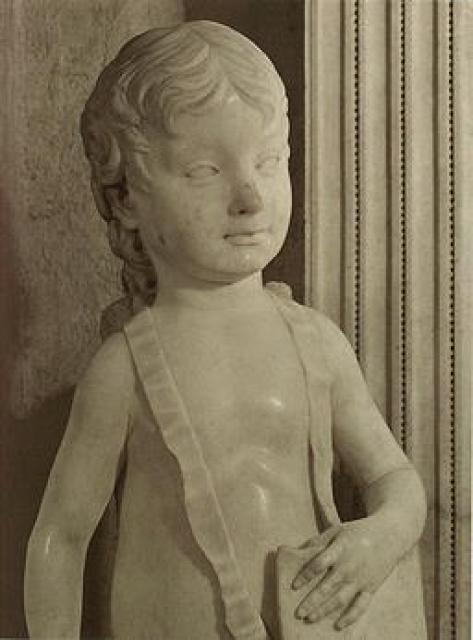
Deziderio Settiano
 Italy
Italy- Desiderio da Settignano
- Early Works and the Revival of Antiquity
- The Emergence of Relief Sculpture
- Portraits and Female Iconography
- Legacy and Recognition
Desiderio da Settignano
Early Life and Artistic LineageDesiderio da Settignano, born in the small town of Settignano near Florence, was an Italian sculptor active during the early Italian Renaissance. Coming from a family of stonemasons, he inherited a deep understanding of the material he would later master.
Desiderio did not directly train under the renowned sculptor Donatello, who had revolutionized sculpture, but likely apprenticed in the workshop of Bernardo Rossellino. Donatello's influence on Desiderio's work is evident throughout his career.
Early Works and the Revival of Antiquity
Desiderio's early works, such as the tomb of Chancellor Carlo Marsuppini in the church of Santa Croce, showcase his profound understanding of classical art. The monument combines architectural and sculptural elements, adorned with intricate details and symbolic imagery. Desiderio surpasses his mentor in the richness of decoration and the refinement of architectural forms.
The Emergence of Relief Sculpture
The advent of perspective in painting influenced the development of relief sculpture during the early Renaissance. Desiderio masterfully employed this technique, as seen in the central panel of the Tabernacle in the church of San Lorenzo. Depicting a classical interior, the relief's depth and lifelike figures demonstrate his ability to translate pictorial qualities into stone.
Portraits and Female Iconography
Desiderio's female portraits reveal the revival of portraiture in early Renaissance sculpture. Influenced by painting and the desire to capture the inner world of individuals, they combine realistic features with idealized beauty. The portrait of Mariette Strozzi in the Berlin-Dahlem Museum exemplifies this delicate balance, conveying an enigmatic yet captivating expression.
Legacy and Recognition
Desiderio's work came to embody the elegance and sophistication of early Italian Renaissance sculpture. His unique ability to infuse stone with life and emotion earned him widespread admiration. Giovanni Santi, the father of Raphael, praised him as "gifted, tender, and lovely." Desiderio's sculptures continue to occupy a prominent place in the history of Italian art, admired for their exquisite craftsmanship and timeless beauty.



