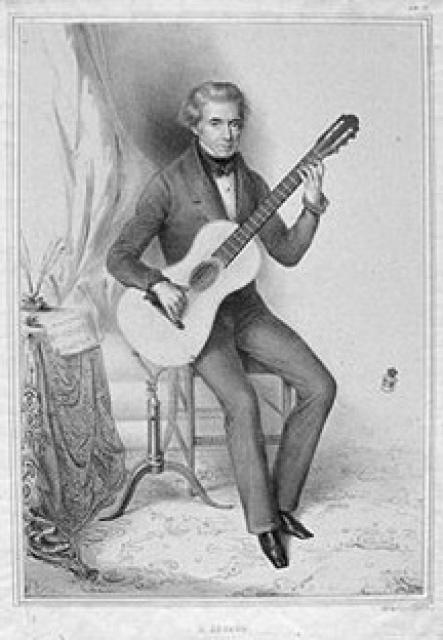
Dionisio Aguado
 Spain
Spain- An Innovator in Spanish Guitar: Dionisio Aguado
- Early Life and Education
- Teaching and Paris Years
- Partnership with Fernando Sor
- Compositions and Pedagogical Legacy
- Later Years
An Innovator in Spanish Guitar: Dionisio Aguado
Dionisio Aguado (circa 1784-1849) played a pivotal role in shaping the Spanish school of guitar performance alongside Fernando Sor. His groundbreaking techniques and influential pedagogical works left an indelible mark on the guitar world.
Early Life and Education
Born in Spain, Aguado received his musical education at a church seminary, where he studied guitar under Padre Basilio and Miguel Garcia. By the early 19th century, he had begun composing for guitar, notating his works in standard musical notation rather than tablature, a deviation from the norm at the time.
Teaching and Paris Years
In 1803, Aguado settled in Fuensalabra, where he taught guitar until 1824. During this period, his "Colecci?n de estudios para guitarra" (Collection of Studies for Guitar) was published in Madrid. Following his mother's death in 1824, Aguado relocated to Paris, where he quickly established himself as a renowned performer and teacher. He published the French version of his "Methode complete pour la guitare" (Complete Method for Guitar) during this time.
Partnership with Fernando Sor
For over a decade after his arrival in Paris, Aguado collaborated closely with Fernando Sor. They performed as a duo and Sor dedicated the duet "Two Friends," Op. 41, to Aguado. Despite their friendship, they differed in their approach to guitar technique. Sor favored using the pads of his right-hand fingers, while Aguado advocated for using the fingernails, a pioneering idea that resulted in a brighter and more robust sound.
Compositions and Pedagogical Legacy
Aguado's compositional output, though relatively small, was of great depth and substance. No comprehensive catalog of his works exists, but several of his etudes, rondos, dances, fantasies, and other pieces are known. His "Metodo complete pour la guitare" gained immense popularity in the 19th century and was translated into multiple languages.
Later Years
Aguado returned to Spain in his later years, where he continued to teach and revise his "Metodo complete pour la guitare," publishing it as "Nuevo metodo para guitarra" (New Method for Guitar). He passed away in 1849, leaving behind a lasting legacy as an innovator in Spanish guitar technique and pedagogy.


